Showing posts with label connection. Show all posts

March 22, 2023

Puzzling predicaments

Have you ever done a jigsaw puzzle?  Remember the wooden ones or cardboard ones where a circle went in the circle hole or the cow in the cow silhouette?  We graduated to 10-piece puzzles and then 50 pieces.  Some folks got so into it that they do 500- or 1000-piece puzzles.

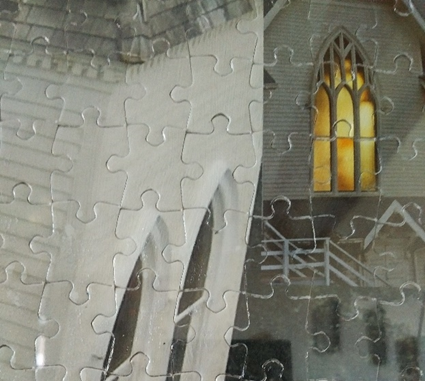
Life has felt like a jigsaw puzzle where we only have some of the pieces and there’s no picture on the box.  For some of us, this has led to a sense of anxiety, anger or apathy.

On this the third anniversary of going into shut-down, how do we put the puzzle back into a coherent picture?  How do we see what the picture is, feel like we are shaping it rather than falling into despair?  Especially when we are dealing with a massive deficit as a congregation?  It would be easy to panic or to give up.  But as followers of Jesus, we are reminded that Jesus points to a different way of seeing, a different way of acting in the world.

The story of the man born blind is worthy of a movie or epic novel.  What must it be like to have grown up without sight, only to have some interfering busybody come along. Did he sign a consent form?  Did Jesus explain the possible side effects such as being pulled into an interrogation by the religious authorities?  Did the man want to see?  Or was he happy with his life?

And who really couldn’t see in this story?  The disciples were struggling with the age-old question of why do bad things happen and assuming that it must be punishment for something the man did or his family did.  As if God sent blindness to punish the individual!  We still often think that when we hear about tragedies, asking what the person did to deserve the situation they find themselves in.  Why did Dad get cancer?  Why did Grandma have a heart attack?  Why were two police officers gunned down in Edmonton? Why are libraries in Winnipeg installing metal detectors in all the entrances? Why? 

I don’t particularly like Jesus’ answer.  So that God can be seen in action in their life, so that God’s healing love can be witnessed.  Not great.  What about the 20 or 30 years the man lived with a difficult disability, the ostracization he and his parents faced?

I don’t believe a God of Love would deliberately inflict suffering on anyone for the sake of winning a debate.  I do believe that Jesus was intentionally and publicly including people that didn’t fit.  He wanted people to have an indisputable and unforgettable experience of God’s presence in the world.  He wanted to shake people’s expectations and assumptions of who God was, what God’s community looks like, and who is worthy of God’s grace.

He wanted people to shake up the puzzle pieces.  To rethink about who fits in and who is out.  To reimagine community and reimagine where God is in the world.

What are the puzzle pieces that we have that aren’t fitting together the way they used to?  First piece is that we have gone through the valley of the shadow of death as a whole world these last few years.  Three years ago, I went to a St. Patrick’s Day birthday party.  It was usually a crowded, happy, raunchy event but that night there was barely a dozen adults in the room, and we were all wondering if it was even safe to be together.  A few days later, we were in lock down.  I was half-planning my funeral because I have asthma and allergies and didn’t think I would survive the virus.  We changed on a dime because we had to.  We learned how to work from home, how to stay away from our neighbors, how to do everything from church to banking online.  Sales of jigsaw puzzles went through the roof when people weren’t hording toilet paper or making sourdough bread or trying to keep their sanity and their marriages and families together.  It was hard.

Many community clubs like Toastmasters, WeightWatchers and Tops closed, churches too of all kinds of denominations.  Girl guides and brownies haven’t come back, schools opened and shut faster than a fridge door, with devastating impacts on children’s mental health and education.  Senior’s homes weren’t much better. People got angry and targeted each other, the health profession, the politicians that listened to scientists.  Dr. Henshaw’s appearance on television saw a surge in dress sales for her outfits and yet also a surge in death threats. And people died.  We were in the valley of more than just a shadow of death.  This has been world-shaking.

But. But.  Even though we are in the valley of the shadow of death, even though we have been blind since birth, even though we have come through many dangers, toils, and snares, the grace of Jesus has brought us safe so far, and that grace will lead us home.

Our book study this Lent had a story of a refugee living in a homeless shelter.  His name was Saleh and as a paraplegic, Saleh had crossed both desert and ocean to get to Canada.  He wanted to raise money for gift cards for his shelter friends. The goal was to raise $5,000 in 36 hours and get the cards to people before Christmas Eve. Impossible? No! He said “In Arabic we have a saying: ‘it is God who guides the hand.’ People told me I couldn’t cross the desert in a wheelchair. With God, I knew I could.” They did indeed meet their goal. Imagine the faith that helped him cross the desert in a wheelchair! We need that faith now!

It takes Saleh’s deep, courageous spirituality to meet challenges like what we have faced these last three years.  It will take deep courage, daring conversations and bold testimony to our neighbors to get through these next years.  But I have no doubt in my mind that whatever jigsaw pieces we have, God’s big picture will come together when we work as a team to puzzle it out together.  In life, in death, in life beyond death, God is with us, we are not alone.  Thanks be to God!


May 04, 2021

Rooted in the Divine, Not in the Carpet


When Tim and I first got together, it was quite apparent that our families were similar.  My grandma was so shaped by the Famous Five and the Temperance Union Movement that she soaked her Christmas cake in Welch’s Grape Juice.  Tim’s grandma would offer great hospitality with shortbread and scotch mints but never had any liquor in the house.  Both our grandmothers were active in Edmonton United Churches, mine at St. Paul’s near the university, and Tim’s at Strathearn United near Bonny Doon.  So when he signed up for a wine-tasting tour one summer while I and the kids were taking camp programs at Naramata Centre, I felt a little nervous.  I never expected it to become a life-long interest for him the way it did.  He graduated from Baby Duck to Gewurztraminer, while I stuck to the occasional chocolate ice wine, not a common vintage.

It made our families nervous, but not enough to denounce us or disinherit us.  Then Naramata Centre had a a course on wine and spirituality.  Tim enjoyed visiting Blasted Church, Elephant Island and Township 7, developing a taste for merlots and other reds.  I discovered a passion for chai tea lattes.  Preferably with a subtle dusting of cinnamon.  It could have led to conflict, but we agreed that we still loved each other despite our different tastes in beverages.

Some people were so offended by the course that was offered that letters were written to Naramata and the Observer Magazine that threatened and blustered.  No more donations were going to go their way for supporting such outrageous attitudes and promoting alcoholism.  I didn’t pay much attention to it at the time, being very busy with raising two active children.  But I know it hurt some people to the point that they pruned themselves away from their church.

Congregations can lose people so easily that way.  And if it’s not about attitudes around alcohol, it’s the color of the paint for the office, or the removal of a banner or something else.  One of my classmates found out that their big split was over carpet color and 20 years later, people were still not speaking to each other.  That’s nasty in a small town, and I’m pretty sure that’s not what Jesus had in mind.  But it may have been exactly what John had in mind when he wrote, “If you say you love God but hate your sister or brother, you are a liar.”

Strong words, John!  How do we love our siblings in Christ especially when they are so not what we expect?  And of course, we’re supposed to practice loving the members of our faith community so we will be able to love our neighbors too.  Love is the fruit of the Spirit that we are supposed to be able to grow. 

This is easier said than done.  We can get caught up in feelings of frustration and concern, even fear when we don’t get the results we hope for.  And we can bend over backwards to be nice Canadians.  But we are not called to be nice!  We are called to be loving.  Sometimes that looks the same, but it is rooted in a different soil.  Being nice can lead to an artificial harmony where everyone talks and acts like we’re a loving family.  We don’t want to say how we feel because it might hurt someone’s feelings, or even worse because we don’t know how to say it in ways that will be kind.  So people turn a blind eye, or pretend they are happy or do their best to ignore the behaviors that are hurtful.  We ignore comments like “people always” or “people never”.  We leave conversations unsettled and unsure why we are feeling uncomfortable.  We say nothing at work when a racist or sexist joke is made. We don’t talk about the family member struggling with mental health issues that is phoning us at all times of night and day that have us feeling overwhelmed or sleep deprived.  Then all of the sudden, the carpet color comes up and boom!

Artificial harmony is like a pot on a stove that has a lid tightly attached and nowhere for the steam to go.  Eventually it explodes and people wonder how it got so hot.  Then we end up with two, three, five, even eight churches where once there was one.  There are towns in Ontario where there are three United Churches in the same block, one that started out Methodist, one that was Presbyterian, a Congregationalist and so on and these happened before 1925.  It happens in modern times too, Southern Baptists are losing prominent leaders, especially women, and the United Methodist Church is splitting for many reasons.

How do we avoid getting caught up in carpet issues and stay rooted and grounded in Christ?  How do we hear the call to bear fruit?  Loving fruit, full-bodied and richly flavored fruit?

We stay connected not to carpet conflicts but to the vine that nourishes us.  We stay connected to God, our Higher Power, Great Architect, Great Spirit, however you want to label the Good Orderly Direction.  We stay connected by being curious about our own emotional reactions when we feel triggered and ask God to care for these tender trigger spots.  We stay connected by confessing to ourselves and to God the times we haven’t stayed connected or even wanted to be connected to the True Vine. We stay connected by caring deeply about the challenges our neighbors are facing and not assuming that they are being deliberately hurtful.  We stay connected by getting coached in that connection.  Coached by this congregation as we practise together how to pray, how to connect to God through song and through ritual, how to be open to hearing God’s word through our scriptures.  When we commit to curiosity, confession, coaching and caring communication with God and one another, the fruits of the spirit are abundant, and we prove ourselves loving disciples of Christ, rooted in the divine.  May it be so for us all!