Showing posts with label grumpy. Show all posts

March 13, 2024

Snakes Alive!

The things we do to survive difficult times are truly surprising.  Wilderness survival has become a staple on Netflix and YouTube, with shows like Man Tracker being popular.  But the ancient Hebrews, wandering around in the wilderness, didn’t have encyclopedias to tell them how to survive, or what to eat.  They didn’t have an app on their phone pointing to where the nearest grocery store was, and they certainly couldn’t skip the dishes!  Survival was not something they could take for granted.  So when snakes moved in to their campground, no wonder they were upset.  They couldn’t contact Fish and Wildlife and rent a snake trap to deal with the infestation.

They did have a clear understanding that their choices had led to their misfortunes.  Their decision to be negative, to complain repeatedly about the food like a bunch of teenagers in the school cafeteria, was very human.  There are at least 14 instances in the books of Exodus and Numbers, of the people complaining about the food or the water, like a broken record that went on and on.  Despite everything Moses did, finding rocks with water in it, or manna on the ground, or quails in the air, the people still complained.  Slavery where they had no choices and they knew what would happen every day of their lives, was better than the unpredictable never-ending hiking trip that left them all tired and grumpy at the end of every day.  Freedom is not as wonderful as they thought it would be.  They were still part of the slavery mindset where it was always someone else’s fault.  They were addicted to seeing only the negative in every situation.  Surprisingly, snakes are supposed to be better protein than beef, and according to one website, rattlesnake meat is particularly delicious.  And since Moses hadn’t gotten time to write down what was clean and what was unclean yet in the book of Leviticus, snakes could have been a real boost to their diets.  At least, if you don’t eat the poison glands in the heads, and don’t get bitten as you try to catch them.  Maybe Moses or the writers of Leviticus knew something about those snakes we don’t.

Whatever the reason, God and Moses cooked up some art therapy for the Hebrews to get them looking up.  They cooked up a snake on a stick, to remind the folks that they had someone to trust in that was more powerful than snakes.  To remind the folks to go to prayer first, not negativity.  To break their slave thinking which assumed the worst in all situations.  To put God right in the centre of all their calamities and fears and frustrations.

Jesus continued that metaphor and built on it in a night-time conversation with Nicodemus.  Nicodemus, an educated believer, was an expert in the bible.  He wanted to figure out if Jesus was legitimate or just a con man, if Jesus was rooted and grounded in his scriptures or just inventing whatever he felt like.  This was a test of Jesus and his theology by a temple official.  This was not a casual chat about whether or not snakes might be edible, a conversation that was light and fluffy between two strangers wondering if they might be able to become friends.  This was the meeting of two great minds to talk about deep philosophical stuff.  Jesus could throw obscure quotes from the bible at Nicodemus because Jesus had studied it well.  Nicodemus would have been impressed that Jesus knew that odd story, and he would have taken it as a sign that Jesus had done his homework.  From the questions Nicodemus asked Jesus, he was honestly open and curious as to what Jesus was teaching, and was listening hard to understand.  That teaching was surprising on so many levels.  We tend to focus mostly on John 3:16 because that has become the most famous passage of the bible, seen at football games and on billboards.  It also has become interpreted in toxic ways.  One person described John 3:16 as a “believe it or else” warning sign used to divide and discriminate against people that don’t believe in Jesus in just the right way.  Which is ironic, because Nicodemus came with questions and an attitude of curiosity.  Jesus treated him with deep respect, engaging his questions, inspiring deeper questions, and having a rich, metaphorical conversation.  If Nicodemus were here today, would he read John 3:16 as an invitation to deeper conversations or as a condemnation of himself as not doing Christianity right?  Would the people he talked to today condemn him for not understanding, or encourage him to keep questioning?  It’s too bad that we stop at 3:16, because 3:17 is in my mind a much more invitational and hopeful verse.  Jesus came into the world not to condemn the world but that the whole world might be saved.  In some ways, that is the true scandal of this passage.  Our secret deeds will no longer be secret, our actions that we’re not proud of, these will be as evident and as prominent as if we had put them on a stick and marched them in a parade in the downtown on Canada Day.  But the whole world will be saved not only from our faults and mistakes and secrets, but from all that has us feeling scared or angry.  The whole world.  Not just the pretty ones, the famous ones, the straight ones, the rich ones, the powerful ones, but the whole world.

The whole world includes people of all ages, races, ethnicity, abilities, sexual orientation, gender identity, and family structure.  It also includes creation, snakes and all.  Jesus didn’t condemn Nicodemus, who helped care for his body on Good Friday.  Jesus came for all of us, in all our glorious diversity.  Whether we are campers who like our microwaves, or survivalists who want to know how to cook the snakes that are edible, we are part of the world that Jesus came to be lifted up for.  May we find courage and strength no matter where we find ourselves or what we are struggling with, by keeping our eyes on Jesus.  Amen.


July 12, 2022

Testing Jesus

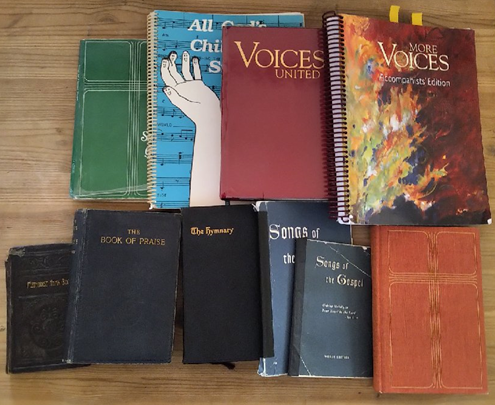
One of the things I seem to be accumulating is a collection of hymn books.  I have the red hymnbook from the 1970’s, the green hymn book from the 90’s, Voices United and More Voices.  I even have the 1950’s Songs of the Gospel which was the first hymn book I ever sang from as a child.  And now that I’m on a subcommittee helping with the new hymn book with over a thousand submissions we’re wading through, I’m very aware of the hard work that goes into putting it together.  And how much compromise and testing goes into selecting hymns. And how no matter how hard we work, there will be someone unhappy with the decisions that were made. 

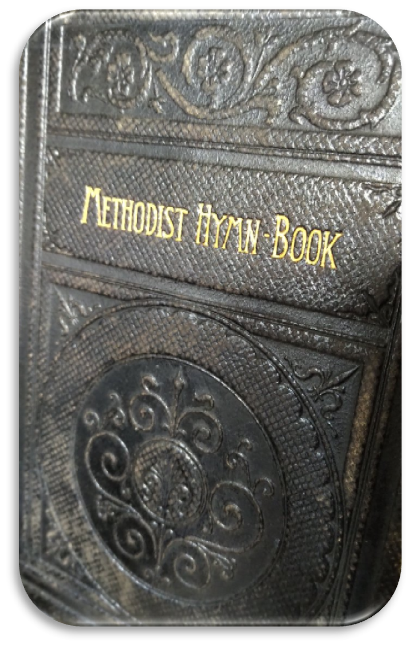
Cecile passed on this little gem to me (pictured on the right here) when they were getting packed up for their move.  It is a Methodist hymnbook, (Methodists were part of our founding congregations, where we get the dove in our crest), and the preface described the need for a hymn book for the newly amalgamated Methodist Church of Canada of 1874, between the Wesleyan Methodists and the Methodist New Connexion of Canada. They wanted a Canadian hymnbook that would unify them in song.

But there’s something about hymn books that have the critics hunting for all the problems they can find.  When Voices United came out, I went through the Green Hymnbook to see which were kept and which were included.  There were a few, like “Give me Oil in my Lamp” that I was surprised didn’t make it.  So, it was amusing to see someone wrote in this old copy, “Why omit Charles Wesley’s ‘Rejoice the Lord is King?’”

Testing the decisions of the hymn committee.  We do that.  We test.  We challenge.  We question, especially anything that is new.  Maybe because we are in a grumpy mood, or because we have a level of expertise that is higher than what we think the other person has. Or because we have an idea worth contributing.  Or because we are coming from a less than humble attitude of superiority.  Or because we find someone else’s idea threatening.  Or even worse, because we find that person themself threatening.

The lawyer felt threatened by Jesus’ new approach.  Maybe he distrusted the charisma or the leadership skills, the new ideas or the sense of authority or the growth of new disciples and followers.  Maybe he had a toothache that day, or his supper hadn’t agreed with him.  Regardless, he didn’t like what Jesus was doing, and he was determined to test Jesus.

So Jesus pulled out a story that has become so famous that as soon as we hear the words “Good Samaritan”, we know it.  Folks who have never heard the story may still know the phrase, and it’s interesting that when I got my Naloxone training, I was told about the ‘Good Samaritan’ law, which was put in place so that if one addict tries to save another addict’s life from an overdose, they will not be arrested.  Good Samaritan was even used this week for a CBC story of people helping pull a man out of a burning car in Ontario. It’s a familiar phrase and there may be people who have no idea that Jesus invented it in response to being tested.

It was a shocking story, deliberately challenging the lawyer so badly that he could not answer Jesus’ question of who actually acted like a neighbor.  If Jesus was here today, the story would be about a Ukrainian civilian who was hurt in a missile strike.  A Ukrainian Orthodox priest walked by and crossed to the other side instead of taking care of the wounded civilian, then President Zelensky also walked by and again crossed to the other side.  Then a Russian soldier walking by found the Ukrainian civilian, dug them out from the rubble of what was left of their house, and carried them to the nearest hospital.  The soldier gave the hospital money for antibiotics and promised to take care of any additional expenses on their return.  The shock of the Russian being the one to help is like the scandalized lawyer’s inability to even say the word ‘Samaritan’.

Jesus tested him, "Which of these three was the neighbor?"  The lawyer answered, "The one who showed kindness."

Jesus challenged his tester to move beyond wordsmithing and legalese, logic puzzles and abstract philosophy which put following God into an intellectual exercise for abstract arguments.  Jesus wanted his tester to see the debate about defining neighbor more than mental gymnastics, but something that challenged the emotions as well as the logic.  And not only moving it from an ethical debate to an exercise in empathy, ultimately moving it into the realm of action.  As one Maritime song put it, move from the head to the heart to the hands.  How do we get our faith to move in that direction?

Someone recently joked that the difference between the Methodists and the Presbyterians is that when you tell a Methodist about a problem, they will say, “I will pray for you”.  When you tell a Presbyterian, they will say, “I will think about you.”  We who are United can combine the best of both worlds, think, pray, and see what we can do, not to take over and fix things for people which just enables them, but what we can do to empower them, help them come up with their own actions and support those actions as best we can.  Our hymns can help us do that.  When we read the words of the hymns, we engage our thinking.  When we hear the music, we engage our feelings.  When we sing the words, we engage our bodies in acting on the words and
feelings.  Test, empathize and act in compassion and love.  The more we do that, the more we become able to think of and respond to the neighbors we are called by God to love. May it be so for us all!