Showing posts with label priorities. Show all posts

August 29, 2023

Sober Judgement?

 What does it take to stay calm in today’s society?  The news seems full of irrational acts by people whom we would think would be rational.  Shootings of store owners because of the flags they fly, people protesting measures that are supposed to protect them from forest fires, even a plane in Russia mysteriously crashing.  How do people justify such choices?

Making sober judgements, as Paul asks us to do, is based on God’s priorities and not humanity’s priorities.  It is not easy either.  We don’t want to burden ourselves with difficult decisions that are logical, because there don’t seem to be any simple or straightforward decisions that are clear.  We look at global warming and agree that something must be done to lower our emissions, yet many politicians still say it is a myth.  Other folks may admit that climate change is real after watching the fire in Hawaii, but then they will say that there’s nothing they can do about it, so let’s keep making profits while we still can.  That doesn't sound like a sober judgement based on God’s priorities.

God’s priorities are to help each other become the body of Christ, a healing community based on ministering to one another.  God’s priorities are that we witness to the world that there are ways of being that do not build up greed and selfishness at the expense of others. God’s priorities are communities of faith that are humble, where everyone reflects on being a holy sacrifice to God.

How hard it is to be humble, in this world that rewards those who brag about being the best debaters, the most likely to start a revolution, or those who amass the greatest fame and fortune in the shortest amount of time.  Jesus knew that struggle, I think, when he turned to the disciples and said, “Okay, give me the scoop.  What’s the gossip about me?”

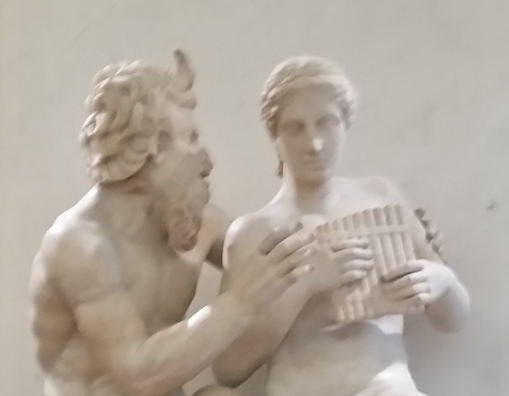
Jesus knew that he had disturbed the powerful leaders enough that he needed a vacation from Jerusalem.  A few chapters back, Herod had chopped off the head of John the Baptist, so Jesus knew it was time to get out of Dodge.  And he was in Caesarea Philippi, a Roman town dedicated to the God Pan.  Sculptures like this one found in Pompeii, were scattered all through the town.  Pan, goat hooves and all, was shown teaching youth the pan pipes and inspiring panic in those he disliked.  And yes, panic, the very opposite of sober judgements, was named after this deity.  Idols like this were challenging for his followers who followed a God that was never limited to a stone image.  Having a conversation about Jesus’ reputation in front of these sculptures would have had the disciples thinking about how different their faith was from the Romans who had invaded their country.

Peter got it.  The contrast between Jesus who was prepared to sacrifice his very life, who preached compassion and justice to everyone he met, with Pan, would have been stark.  Pan represented the ultimate in conforming to the world, a pleasure-seeking, powerful god who didn’t care about others unless they were pretty.  Contrast this to the tradition that Peter and the others had grown up with, a God that is Holy Mystery, beyond complete knowledge, and above perfect description, one that was always seeking relationship.  Not for God’s pleasure, also unlike Pan, but to mend the broken and reconcile the estranged.  God was seeking relationship to build a society where orphans and widows were not forced to become homeless beggars, where power was not imposed by swords and roadblocks but by respect and wisdom. “Who do you say I am”, Jesus challenged, asking Peter to rise above the gossip and come up with his own opinion. 

The lightbulb went off in Peter’s head!  Rather than being conformed to the world of Pan, Peter chose to align himself with his beloved rabbi Jesus, who had so much integrity, so much wisdom, so much power that it was like Peter was able to see God in him.  To Peter in that moment, Jesus was full of the promise of what human beings should be like if they were fully transformed into something that was perfect love.  Wow.

Who is Jesus in our lives?  Some of us may feel that he was a good teacher, and that’s true, and if you do, keep learning from his teachings.  The teachings are powerful, maybe even a little dangerous, and they will challenge you to continue to learn.  Some of us may feel he was a prophet, able to read the signs of the times and the culture of the people he met in ways that surprised those who met him.  Excellent, keep looking at the ways he reads our times even today.  Some may think he was a radical organizer, and he certainly was that, speaking truth to power with tremendous courage regardless of the personal cost he might experience.  And some might experience a sense of profound mystery and wonder when they reflect on who Jesus was.

Regardless of where we are in our understanding with Jesus, we are called to reflect on him.  Who is Jesus to me?  Who is Jesus to you?  That changes as we grow in our faith and is key to when someone asks us why we go to church.  Hopefully, Jesus models the kind of principle-centered human we want to be.  When Jesus is our role model, we can weather the storms of life as a community in ways that build resiliency and hope for ourselves and also all who know us.  It is our witness to the courage our faith gives us, and courage and hope is something the world needs now more than ever.  Let us reject the Pan god and the panic that he inspires, and embrace the sober, loving judgement that Paul, Peter and Jesus used to change the lives of many people around the world.  Amen.


September 14, 2021

Writing on the Wall - Daniel 5

Guess how old the oldest graffiti is?

Long before people began scrawling ‘Kilroy Was Here’ or before craft stores had to lock up cans of spray paint, humans were making graffiti. There are examples of graffiti on the walls and streets of Pompeii, put there before Mount Vesuvius erupted in 79 CE.  Some people argue that the cave paintings discovered in France are the first.  Regardless of when it started, graffiti has a long history, and like modern examples, it has been a record of where people have been and what they have been thinking about.

Often what they have been thinking about has been the issues they feel most passionate about – hunting mastodons for the early Cro-Magnons, where to find women of easy virtue in Pompeii or how ancient tourists felt when standing at the foot of the pyramids in Giza.  Early Christians wrote on the walls of their catacombs in Rome, where they were able to worship safely and secretly together during times of political turmoil.

But I think the oldest written story about graffiti is this one in the book of Daniel.  It has become such a common phrase, 'The writing on the wall’ that I suspect most people don’t know or remember that it comes from the Bible.

Daniel, for those who haven’t heard of him, is more famously remembered as surviving a night with starving lions, protected by God because even the threat of death would not shake his public commitment to his faith and to God.  Like his friends, Shadrack, Meshack and Abednego who were thrown into the fiery furnace, Daniel was part of the first generation of captives from Israel to be targeted for cultural assimilation into the Babylonian system.  They were chosen from the rest for special education, and special food to enter government service.  Their names were changed from typical Hebrew names to Babylonian ones.  Daniel and Mishael with ‘el’ in their names, another name for God, were to be called Belteshazzar, and Meshach.  They were also told to eat non-kosher foods too, something Daniel was able to foil with a clever plan (Daniel 1). 

They stayed committed to the God of their ancestors, which is an amazing feat of itself.  It was common for conquering countries to brag that their gods were the source of their victories.  When they fought, they believed their gods fought, and when they won, their gods won.  A winning God was worth praying to, and a losing God was either seen as dead or added to the family of Gods.  In Egypt and in Greece there were dozens of gods because of this.  The theology of the time thought Yahweh had failed and lost and was no longer to be honored.

So Daniel, by going out on a limb and speaking for God, was being radically counter cultural.  By reading and interpreting the words written on the wall, he was declaring to the thousand officials that his God was not forgotten, nor had he been assimilated, and even though he was surrounded by people who were the ruling class, he had not forgotten to follow the God who cared about the weak, the down-trodden, the widow, the orphan.  The God who cared for the conquered people living in a foreign land, and the slaves who needed rescuing from the powers of Egypt.  The God who nurtured community and compassion. The God of Abraham and Sarah, Jacob and Joseph, Moses and Miriam, the God of Covenant not conquest.   And when Daniel saw the writing on the wall, he probably knew that God had not forgotten him either.

We too can see the writing on the wall if we know where to look.  We are at a challenging time in the history of humankind, the most challenging in my lifetime, although not for those who lived through the Depression or World War Two.  The extreme heat we experienced this summer, another bad year for crops as well as glaciers dying and permafrost no longer permanently frozen, is a sign that global warming is real and needs to be addressed.  20 years since 9/11 and the Taliban are back in power in Afghanistan.  Surging numbers of Covid cases and hospitalizations in Alberta with vaccination rates plateauing and yet people are surprised that they are being asked to wear masks again.  Like King Belshazzar, we have been focused on the wrong things.  Daniel was focused on different priorities, God priorities.   

Jesus was the same way.  He knew that if he continued to challenge the priorities of the people in power, he would end up in trouble.  He knew that challenging the status quo would have only one outcome.  But he kept his focus on God’s priorities and was prepared to do whatever it took to meet those priorities.

God’s priorities haven’t changed.  Caring for the folks without hope, the people who feel they don’t have power over their lives.  The lonely, the frustrated, and yes, even the folks who think they have all the answers, and the ones who party like kings.  When do we take time to ask what God might think of our society, how God might measure us, count us, weigh us, and challenge us?  The time is now.  The opportunity is there, and the action is simple.  Whether we request a mail in ballot, a trip to the advanced polls, or show up to cast our vote, let’s vote as if we have seen the finger of God writing on the wall of our world.  Vote as if this is the most Christian thing we can do.  Vote as if this is how we follow Jesus even if it looks like it will end up in suffering and challenge and change.  Vote as if we are Daniel, telling a powerful society  that the writing is on the wall.  Because we are called to follow Jesus, and speak truth to power, even if it challenges the culture, even if it goes against what everyone thinks we should do.  And because we are called to see the writing on the wall and tell it to the people even when they don’t want to hear it.  Let’s be brave and bold as we serve Jesus, empowering and inspiring each other to make a difference in the world!

What old bible quote are you interested in hearing a sermon on?  Contact me and I will put it together.  Or leave a comment below.

September 18, 2019

What do you sign up for?


This is the week to sign up for fall programs.  The multiplex has their registration night on Wednesday, clubs host open houses, organizations start advertising their activities, and everyone hopes that people will come back and new folks join.  We have a smorgasbord of things we can try in this community, from pottery to hand bells to yoga and gymnastics, hockey, photography and golf.  It’s hard to choose.  Some people do the same thing year after year and others like to try something new every year.
I love signing up for new groups and trying out new things.  I have lost track of all the different stuff I tried at one time or another.  There’s something wonderful in taking the brave step to see if I can decorate a cake or macrame an owl.  For a moment the whole world feels open with great possibilities.  Even though I never became a great cake decorator or a prima ballerina, I had fun trying.
The spirit of exploration is something I tried to encourage in my children too, as they grew up.  They could choose an activity, something physical for after school.  One year, the gymnastics coach came up to us and asked if my 8 year-old son would like to join the competitive boy’s team.  There were a few extra practises that would be involved, and a few more fees to pay, but he could join the pre-Olympic training program.  Apparently, it wasn’t too late for 8 year-olds to start to prepare to compete, but it was too late for his 6-year-old sister who should have started competitive at the age of five.  Wow.
How many more practises were needed?  Something like 4 days a week and two hours on Saturday.  Once they got older, it would be 5 days and all Saturday.  For a seven-year old! I really didn’t know what to say.  I knew that some of my friends had their kids in a different program every night of the week.  One of my friends had her kids in Guides, karate, swimming, guitar, dance and voice lessons.  They seemed to thrive on it and one of them even went to Julliard.  Others built their lives around hockey every night and on the weekends, or indoor soccer, but I just couldn’t wrap my mind around being in the gym that many hours a week.  In the end, we decided as a family to keep gymnastics as a fun activity that the kids did for several years, and they can still do cartwheels or flips or fancy tricks on the trampoline from time to time.  One kid even earned some money as an assistant coach one year.  But they never went to the Olympics and they never competed.
One of the things it made me do is look at what values I believed in, and what did I want to pass on to my children.  I believed in doing one’s best, working hard, and keeping fit.  I didn’t believe in living vicariously through my children’s successes, or that competition was the be all and end all of childhood.  I wanted my kids to have fun and enjoy life’s opportunities, and if something had become a real passion for them, I would have supported that to the best of my abilities.  But my picture for them was not to become famous or rich, but well-rounded and healthy.
God’s vision for us is not to become famous or rich.  God’s vision is not just about us as individuals either.  God’s vision is bigger than a parent’s for a child or a coach’s for a star player or a teacher’s for a classroom.  God’s vision is for nations and countries and cultural groups as a whole.  God wants to shape whole nations and even the world like a potter shapes clay. 
What is it that God calls us as a nation to?  What is it that God wants us to repent of, to turn from?  What does God envision shaping us into as a potter shapes clay?
What if we looked at the world through God’s eyes and asked what we thought God would want from us?  What if we could see the storms on the East coast, the melting permafrost, the vanishing glaciers, the starving polar bears and asked ourselves what Canada would need to look like to be living in respect in creation?  What if we took seriously the scripture, “For God so loved the World”?
As Jesus put it, who among us would build a skyscraper without making sure they had a decent bank loan, engineering teams building the blueprints, competent contractors and skilled trades workers to put the skyscraper together?  Yet we either can’t or won’t look past our short-term pleasures and needs to the long term issues of justice and sustainability.  We have an election coming up that will probably focus on character assassinations, oil jobs and avoiding racist comments.  Where will the long-term vision be found, not just for Canada but for the whole world?  Who will ask the tough questions, like why women politicians who talk about the environment have death threats and foul language when they are out in public with their children?  What kind of world do we want for our grandchildren and great-grandchildren?
God calls us to look at our priorities.  Jesus calls us to test our loyalties.  And our United Church creed reminds us that our faith is about love in action, to live with respect in creation, to love and serve others, to seek justice and resist evil.  To repent and turn to God who can make all things new.  Let’s sign up to live into our creed, to listen to our potter, and heed the call of Christ, our coach and teacher.
Dear God, help us rejoice in signs of hope like bamboo cutlery and paper straws, electric cars and soap made from carbon capture technology.  Help us also roll up our sleeves and commit to loving this beautiful world you have created.  Amen.