Showing posts with label neighbors. Show all posts

July 12, 2022

Testing Jesus

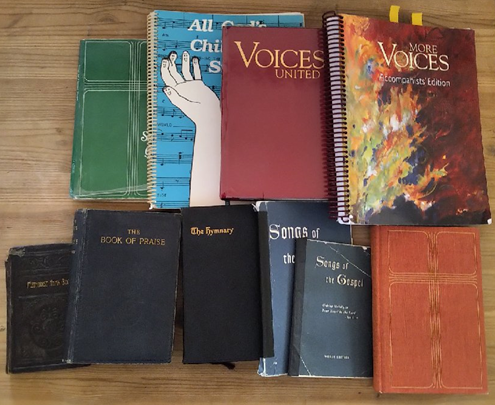
One of the things I seem to be accumulating is a collection of hymn books.  I have the red hymnbook from the 1970’s, the green hymn book from the 90’s, Voices United and More Voices.  I even have the 1950’s Songs of the Gospel which was the first hymn book I ever sang from as a child.  And now that I’m on a subcommittee helping with the new hymn book with over a thousand submissions we’re wading through, I’m very aware of the hard work that goes into putting it together.  And how much compromise and testing goes into selecting hymns. And how no matter how hard we work, there will be someone unhappy with the decisions that were made. 

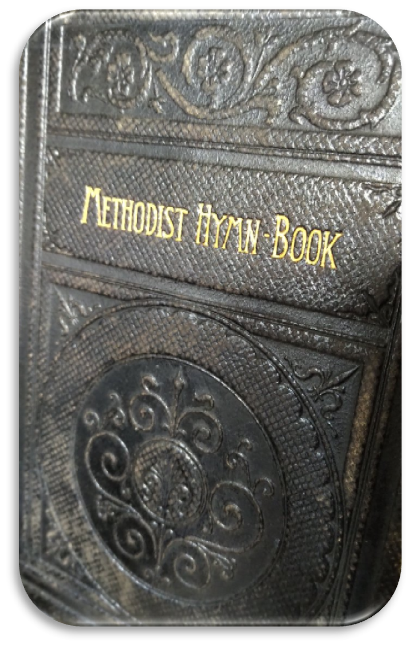
Cecile passed on this little gem to me (pictured on the right here) when they were getting packed up for their move.  It is a Methodist hymnbook, (Methodists were part of our founding congregations, where we get the dove in our crest), and the preface described the need for a hymn book for the newly amalgamated Methodist Church of Canada of 1874, between the Wesleyan Methodists and the Methodist New Connexion of Canada. They wanted a Canadian hymnbook that would unify them in song.

But there’s something about hymn books that have the critics hunting for all the problems they can find.  When Voices United came out, I went through the Green Hymnbook to see which were kept and which were included.  There were a few, like “Give me Oil in my Lamp” that I was surprised didn’t make it.  So, it was amusing to see someone wrote in this old copy, “Why omit Charles Wesley’s ‘Rejoice the Lord is King?’”

Testing the decisions of the hymn committee.  We do that.  We test.  We challenge.  We question, especially anything that is new.  Maybe because we are in a grumpy mood, or because we have a level of expertise that is higher than what we think the other person has. Or because we have an idea worth contributing.  Or because we are coming from a less than humble attitude of superiority.  Or because we find someone else’s idea threatening.  Or even worse, because we find that person themself threatening.

The lawyer felt threatened by Jesus’ new approach.  Maybe he distrusted the charisma or the leadership skills, the new ideas or the sense of authority or the growth of new disciples and followers.  Maybe he had a toothache that day, or his supper hadn’t agreed with him.  Regardless, he didn’t like what Jesus was doing, and he was determined to test Jesus.

So Jesus pulled out a story that has become so famous that as soon as we hear the words “Good Samaritan”, we know it.  Folks who have never heard the story may still know the phrase, and it’s interesting that when I got my Naloxone training, I was told about the ‘Good Samaritan’ law, which was put in place so that if one addict tries to save another addict’s life from an overdose, they will not be arrested.  Good Samaritan was even used this week for a CBC story of people helping pull a man out of a burning car in Ontario. It’s a familiar phrase and there may be people who have no idea that Jesus invented it in response to being tested.

It was a shocking story, deliberately challenging the lawyer so badly that he could not answer Jesus’ question of who actually acted like a neighbor.  If Jesus was here today, the story would be about a Ukrainian civilian who was hurt in a missile strike.  A Ukrainian Orthodox priest walked by and crossed to the other side instead of taking care of the wounded civilian, then President Zelensky also walked by and again crossed to the other side.  Then a Russian soldier walking by found the Ukrainian civilian, dug them out from the rubble of what was left of their house, and carried them to the nearest hospital.  The soldier gave the hospital money for antibiotics and promised to take care of any additional expenses on their return.  The shock of the Russian being the one to help is like the scandalized lawyer’s inability to even say the word ‘Samaritan’.

Jesus tested him, "Which of these three was the neighbor?"  The lawyer answered, "The one who showed kindness."

Jesus challenged his tester to move beyond wordsmithing and legalese, logic puzzles and abstract philosophy which put following God into an intellectual exercise for abstract arguments.  Jesus wanted his tester to see the debate about defining neighbor more than mental gymnastics, but something that challenged the emotions as well as the logic.  And not only moving it from an ethical debate to an exercise in empathy, ultimately moving it into the realm of action.  As one Maritime song put it, move from the head to the heart to the hands.  How do we get our faith to move in that direction?

Someone recently joked that the difference between the Methodists and the Presbyterians is that when you tell a Methodist about a problem, they will say, “I will pray for you”.  When you tell a Presbyterian, they will say, “I will think about you.”  We who are United can combine the best of both worlds, think, pray, and see what we can do, not to take over and fix things for people which just enables them, but what we can do to empower them, help them come up with their own actions and support those actions as best we can.  Our hymns can help us do that.  When we read the words of the hymns, we engage our thinking.  When we hear the music, we engage our feelings.  When we sing the words, we engage our bodies in acting on the words and
feelings.  Test, empathize and act in compassion and love.  The more we do that, the more we become able to think of and respond to the neighbors we are called by God to love. May it be so for us all!

August 31, 2021

“Am I My Brother’s Keeper?”

How many of us remember the question, “Am I my brother’s keeper?”  Despite being a bit of a bible geek, I did not remember where it was found in the bible and did a google search to figure it out.  Much to my surprise, it wasn’t a trigger that inspired a parable by Jesus, nor was it a question asked by the Pharisees, or even a phrase that Paul had coined in one of his letters.  It was, however, in Genesis 4.

The last time I read that story was as a kid in my illustrated story bible.  ‘Cain and Abel’ is a tale of common humanity.  Jealousy of a sibling is something many people are familiar with although not many will admit it.  Even more common is making an excuse when caught red-handed.  Cain defensively and angrily tried to deflect God’s question. 

God told Cain to let go of his anger and jealousy, but Cain hung onto it, and nursed it, according to the scriptures.  As James wrote in his letter, “let everyone be quick to listen, slow to speak, slow to anger; for your anger does not produce God’s justice.”  Cain’s anger did indeed not produce God’s justice.  Cain fed his anger until it boiled over into violence.  And then he refused to take responsibility by deflecting God’s question.

We’re not murderers, as far as I know, but the question of “Am I my brother’s or sister’s keeper?”, feels central to the tension we are now seeing in many conversations.  It is a difficult ethical question to ask of ourselves.  The people who are covid deniers or anti-vaxxers are ready to accuse us of being sheeple and worse at the slightest opportunity.  They promote medications that are proscribed for livestock, as if that is safer than a vaccine developed by some of the most educated and dedicated medical experts in the world.  Their anger does not lead to justice, which at this time would be vaccinations distributed to more than just 2% of the world’s population.  Nor does it build up love and community in this country.

“Am I my brother’s keeper?” is a justification for not taking care of one another, not taking responsibility for how our actions impact others.  Remember the first Star Wars movie when Han Solo delivered R2D2 and Princess Leia to the Rebel Camp after escaping Darth Vader and the Death Star?  She says to him, “It’s not over yet”, and Han says defiantly, “It is for me, sister. Look, I ain't in this for your revolution, and I'm not in it for you, Princess. I'm in it for the money.”

That is where a lot of people are right now.  They are in it for themselves, and no one else.  They struggle to deal with change or with being asked to do something like wear a mask or get a vaccine that doesn’t benefit them or their bank accounts.  They are coming from a place of defensiveness that says “I don’t want to do anything someone else tells me I should do” or “I don’t need to care about others getting sick”.  They are coming from a place of entitlement, or anger or shame or fear or denial.  Ultimately, they don’t want to have to change for someone else.  They fear being controlled by someone else.  And their fear of being controlled is so strong that they do irrational things.

It’s always easy to see when it’s them out there that are stuck in the question of “Am I my brother’s keeper?’  But what about us who want to follow Jesus?

Christians are not called to judge our neighbors, as tempting as that might seem.  Or as widespread as that might appear – judging those who have vaccines, those who don’t, those who are staying home, those who went to the Calgary Stampede, those who have Covid, those who don’t believe in Covid, those who sanitize their hands, those who hug everyone they meet, those who know who they will vote for, those who don’t know if it will make a difference whether they vote or not.

As Jesus said, “Let he who is without sin cast the first stone.”

We are to look within, noticing the times we resort to anger or respond with greed or jealousy or pride or denial or resentment.  The times we lie, or say nasty things about people behind their backs, the times we don’t listen to someone with a different point of view.  The times we lash out or the times we fail to speak up.  Especially now, the times we need make changes and accommodations that we feel are unnecessary or unimportant.  More now than ever, change will be hard and resented and rebelled against.  Clinging to human traditions when they no longer help us connect with the holy can lead to the exact kind of Pharisee thinking Jesus was condemning.

It’s not how our church is set up, or how we feel about wearing masks in church, or being asked if we are double-vaccinated or where we sit that makes us unclean.  It is the anger and resentment, or stubborn clinging to what we think is the right way of doing things that can break down our relationship with God.

Ultimately, we are called to be more than our brother’s keeper.  We are not to enable or abandon them, but to love them.  Jesus taught that we are to love our God with all our heart, with all our soul, with all our strength, and with all our mind; and love our neighbor as much as we show compassion to ourselves.  That is what is truly important.  Loving God, loving neighbor, loving self.  We can do this, and when we do, we are following the way Christ calls us to be, turning back on what makes us unclean and worshiping God in ways that make a difference in the world.  May it be so for us all.


April 10, 2020

Who is Jesus?


Matthew 21: 9-11 The crowds—those who went in front of Jesus and those who followed—were all shouting, “Hosanna to the heir to the house of David! Blessed is the one who comes in the name of the Most High! Hosanna in the highest!”  As Jesus entered Jerusalem, the whole city was stirred to its depths, demanding, “Who is this?”  And the crowd kept answering, “This is the prophet Jesus, from Nazareth in Galilee!”


The heart of the scriptures today is the central question, who is Jesus?  And why was he so special that a spontaneous parade could build up so fast and so memorably?

The Sunshine Coast is a lovely place to visit in the spring, and travel there is very efficient.  The ferries were efficient, and the boarding was smooth until I noticed a cavalcade of bikers driving up the ramp in impressive formation.  I nervously pointed them out to my dad, wondering if we were about to be inundated by a Hell’s Angels convention, but he said that they were probably there for my uncle’s funeral.  I found that hard to believe until I ran into the bikers on the top deck of the ferry.  They were pulling off their helmets to reveal not toughened thugs but lovely grandpas and grandmas, white hair, perms, some of the men with bald heads and Santa Claus beards.  Anything but what I had first imagined.

My uncle had been the president of the local Harley Davidson bike club and they had decided to pay homage to him with an honor ride for his celebration of life.  Later that day they made a spectacular sight driving down the hill to the community hall where the service took place.  Parades to honor special people can be very stirring and inspirational.  The parade for Jesus would have been that way too.  With a heartbreaking twist.  “Save Us, save us!” they cried.  People like you and me living in poverty, living in uncertainty, living with a government who had little respect for human rights, who allowed only full Roman citizens access to public justice systems, who had no foodbanks or schools or daycares or health services, a high infant mortality rate and widespread poverty.  “Save us, Jesus” was a desperate cry, and a prayer from the heart.

Jesus was seen as someone who would help them, heal them and listen to them.  Over the ages, many people have felt the same need to call out for him to save them.

One young lady 800 years ago also called out for help.  She was in her thirties, and was extremely ill.  While she lay on her deathbed, she had a series of visions, powerful images of Jesus.  She recovered and out of gratitude, she had herself locked up in a room of a church in the English town of Norwich, the ultimate in self-isolation, and lived there for the rest of her life, surviving the Bubonic Plague, civil war and religious persecutions.  While there, she wrote the first English book written by a woman, and became known for her image of Jesus as the mother of us all, who weeps when we are in distress, who comforts us when we are scared, and who loves us with a deep motherly love.  She had a little window in her room, and people would come to tell them of their troubles.  They would leave feeling comforted and encouraged.  Some psychologists see her as the first person to be a professional counsellor for the people in her town, the poor and the politician alike. She gave them hope not in herself, but in Jesus who inspired her.  Our own United Church author Ralph Milton, wrote two books about her, and said, “it’s hard to believe that such an open, eloquent, optimistic, joyful book could have been written in such a dark and painful time.”  Her name was Julian of Norwich, and she wrote some words that you have probably heard from time to time, “all shall be well, and all shall be well, and all manner of thing shall be well.”  Sometimes those words seem empty and naïve, but when we remember the context she was living in, the state of violence, the rampant sicknesses, the levels of poverty and the lack of basics like food or shelter, her words become a signpost to keep the faith.

Jesus was not just mother to this lady, but inspiration.  Julian of Norwich, locked in her tiny room for more than forty years, over half her life, was comforted and sustained by her faith and shared that comfort to all who came to her.  The parade of people that showed up at her window made her a famous name and in turn she has inspired many.  We are isolated as she was, locked in because of a dreadful illness, and unsure of what lies ahead for us all.  Some of us are coping better than others.  Some of us have a strong faith that helps us pray, others are still new at this faith business, and unsure of how to pray, what to pray for and how it helps.  Regardless of where we are on our faith journey, let us remember that Jesus was a powerful inspiration to everyone who knew him and even those who only knew him through scriptures to turn to acts of love and compassion for one another.  Like Julian, let us listen in love to our neighbors, let us care for each other as best we can, but let us also remember to put our faith in Jesus, our teacher, our role model, our inspiration and our source of hope.  Amen.