Showing posts with label Ukraine. Show all posts

July 05, 2022

Sow Seeds, Trust the Promise


I love the Canada Day weekend!  Severna gets busy and starts bringing over pots and bouquets, the bedding plants are blooming and spreading, and the seeds are sprouting and growing.  This year, Severna planted lots of sunflowers as they are the symbol of Ukraine.  We know that not every seed will grow or even bloom.  I once saved the flower heads of marigolds and was surprised at how few of the seeds germinated the next spring.  Which may be why marigolds produce such an abundance of seeds in the first place.  Not like the poppies in the back yard of the church who reseed themselves prolifically. 

Tim and I planted tomato seeds back in March. We didn’t have any special starter mix, so they didn’t grow too strong or fast.  Then we bought a can of tomato soup this week and it had tomato seeds as a freebie give away stuck on the can.  It even had a link to a website on how to grow the seeds.  We might just try again with these free seeds.

We know, as all gardeners do, that if we plant tomato seeds, we won’t harvest zucchinis. We are going to reap exactly what we sow.  No exceptions. Paul knew it too.  He was the master of metaphor, something worth reminding folks who take the bible more literally than it was intended.  He knew the use of clear images was how Jesus got his teachings to stick.  And he also knew that not every seed would sprout and grow.

Jesus knew it too.  When he sent out the seventy, he gave them instructions that reminded them of this.  “Expect that some people will be open to your message and hang out with those folks.  If they aren’t open, move on. Shake even the dust off your shoes.”

In other words, when we plant our seeds, ultimately, we need to trust that some, not all of our seeds will sprout without us hovering anxiously over them day or night.  And not to take it personally if our seeds don’t grow.  This is very hard for us all.

I know I have been bombarded by people who do take their seed planting very personally.  They are not content to just plant the seed, but it’s like they take a backhoe to dig a deep pit before throwing the seed in.  Then they hover.  And watch and insist that the seed of faith sprouts as they wait.  It’s like being at a time share – ding ding, another soul saved, and you get salesman of the year award for your two hundred people brought to Christ!  Yikes!  Sounds desperate, like their own salvation is based on how many converts they can make.  And competitive. That doesn’t sound at all humble, does it?

I wonder if we are thinking about planting our seeds the wrong way.  We say things like, “You should come to church” and wonder why people get angry at that comment.  Firstly we started with “You” and topped it off with “Should”, which never sounds loving, humble or trustworthy. And Jesus didn’t tell his disciples to say that either.  They were not setting up churches or doing membership drives.  He said, “go and be with people.  Eat their food even if it’s a nasty looking guacamole that’s been in the fridge too long (okay, I wouldn’t go quite that far).  Go and be a healing presence with them.  Go and help them with their emotional challenges and mental anguish.  Not with an aim of fixing, saving, advising, or correcting them.  That is not humble.”  Jesus wanted his followers to go and love their neighbors. Help them learn to build their health and stability and resilience for themselves.  If the disciples were selling anything, it was a deeper relationship with God.  Not coming to church. Or saving souls.

Be humble.  If the residential school missionaries had come with a humble mindset, how might that have changed the course of history?  If they had come with love and compassion and listened and sat and eaten together and lived in teepees first before they built schools and farms, how much different could they have been when instituting the Indian Act?  If they had focussed on trying to empower indigenous people instead of intimidating and enculturating them, how would our truth and reconciliation needs be different today?  And if we came to everyone we met, listened first, and then did our best to be the healing presence instead of the expert, how could that have shaped the very ethos of what Canada is today?

What would happen if we never tired of doing good, planting seeds?  What if we remembered that it’s all about the love of neighbor and love of self?  What if we worked hard to root out any possible accidental weed of selfishness or superiority from every relationship?  What if we remembered that it’s not about bringing people to church but helping people connect to God? And remember that Jesus had spent time first healing and teaching his followers before he sent them out.  We may not be ready yet to heal if we have not first been healed ourselves and that’s okay. Take time to let yourself grow and sprout before you start planting.

Then let God do the rest!  Ultimately, we and God wants a world filled with people of compassion, courage and kindness.  If we can plant seeds of that for others and they can learn that from us in this church, that’s great, and I hope that’s what we are about. Our mission is to be an inspiring, engaging, empowering community that comes together to worship in all our diversity.  So let’s plant our seeds of love in confidence and courage and hope, then rejoice that God does the hard mysterious stuff of getting our seeds to turn into zucchinis, tomatoes and sunflowers. God loves us, guides us and grows us into resilient people one step at a time, in love and humbleness. May it be so for us all!

June 21, 2022

Over, Under

 When I was a kid, the ultimate test of friendship was the teeter totter on the playground.  Unlike a swing that one person could power all by themselves, a teetertotter needed cooperation to make it work.  If you picked the right partner.

Too big and you would end up suspended up in the air, looking a little silly, and not able to pull your weight in the game of up and down.  Too small and you would end up on the ground and the other person would be the one looking silly. Then there were the extra long teetertotters that could accommodate more than one rider.  We didn’t know we were learning physics or even math in trying to end up with balanced sides.  And wasn’t it wonderful to have a kind teen or adult that would be at one end who could bring us up and down single-handedly?  Teamwork, co-operation, equality and trust were all required.  I remember feeling sad when I got to be too big for my dad to single-handedly lift me on the teetertotter, but by then he was introducing me to the mysteries of catching a ball in a big leather glove.

Teetertotters are often how we view our relationships with others.  Are we on top?  Are we higher than everyone else?  Who has got the power? Anti-bullying educators talk a lot about power and how there are a lot of people striving to have power over other people.  And there are a lot of people who are in situations where they feel like they have no power and feel bullied and depressed.  We know of children who die by suicide because the only power they feel they have left is the power to take their own lives.  Anorexia can be an attempt to find power and talking to addicts and alcoholics I hear the same kind of language, “no one is going to tell me what to do!”  There was a story this week of a Calgary Heart Surgeon who is retiring and has filed a complaint against Alberta Health Services. Why the complaint and why only once retirement is happening? Well, she is the only female heart surgeon in Alberta, and has faced microaggressions, gender bias and outright discrimination throughout her career simply because of her sexuality.  No wonder other female doctors are avoiding becoming heart surgeons!

It's easy to blame toxic masculinity for the competition over power that some say has been with us since the overthrow of mother goddess worship in ancient Europe.  Jean M. Auel, author of the Clan of the Cave Bear series, hypothesized that once men realized that they had something to do with the babies being born by women of the tribes, they became possessive and controlling over who had access to the women.  But I think it’s even more universal than that.  Women can be just as invested in the battle for power, and the worst bullies I had as a child were the girls who made some pretty cruel comments, or even worse, jumped off the bottom of the teetertotter when I was up high in the air.  I came crashing down, bruising my ego and my trust as well as my tailbone.

Toxic lust for power can be seen everywhere we look.  It’s at the heart of the invasion of Ukraine and the January 6 insurrection at the White House, and the Ottawa Convoy where protestors made noise and garbage for over three weeks.  It’s at the heart of the current run for party leadership of the United Conservatives in Alberta.  It’s at the heart of family violence, abusive relationships, racism and homophobia.  It is even at the heart of how we talk about the homeless in our community in Athabasca.

We want power over because we want to feel safe, to feel in control, to feel competent or important.  And we have historically done whatever we could to feel that power.  We put people like my great-grandmother in Bedlam under horrific conditions or locked them in chains in a graveyard to deal with their chaotic mental illness.  Is there a better, more humane way in which to address this toxic culture we live in?

Some folks have traditionally thought all that was needed would be to give power to the powerless, to give guns to victims or karate lessons to scrawny children.  Give a radioactive spider bite to a weak teenager, or a magic wand to a boy forced to live in a closet under the stairs.  From Spiderman to Karate Kid, the theory has been to give power to victims and that will fix society.  However, studies of bullying in classrooms show that when a bully and a victim are separated without any other interventions, the bully quickly finds another victim, but surprisingly the victim will often find another kid to become a bully!  Or the victim becomes a bully themselves, taking a turn on the teetertotter.

Jesus sidestepped the power over-power under teetertotter completely and frequently.  It’s seen very clearly in his approach to the Gerasene. He didn’t respond by bullying, putting more chains on the man, or responding like a victim, reacting with fear.  He connected with engagement and respect.  With questions to learn more.  And with authority and confidence.  But not with intimidating, controlling, blaming or shaming.  And he rid the man of the power that was bullying him, driving him to drastic behaviors. 

When people say that the world does not change, they are wrong.  I drove around Athabasca looking for a teetertotter in a playground and couldn’t find a single one at WHIPS, LTIS or the riverfront.  The world changes.  We can change too.  We may not send demons out of people as dramatically as Jesus did.  But we can face our own inner demons, the urges that demand we grab power over, or even the fears of being dominated by others power, and claim our identity as children of God who called to be freed from the tyranny of our own bullying and victim urges.  We can become sensitive to power dynamics at the root of sexism, toxic masculinity, racism and homophobia.  We can be healed and healer, committed to balancing the teetertotter of power with everyone we meet.  We do this with God’s grace and love; knowing that healing is real, change is possible and new life in Christ will make the world a better place for all!


March 22, 2022

Whose Fault is it Anyway?


1 Corinthians 10:1–14 Flee from idols

Luke 13:1–9 The parable of the barren fig tree.

Can you imagine hearing these scriptures from the pulpit in a  church in L'viv or Mariupol?  I don’t know if these readings are in the Eastern Orthodox Church’s list of what to read in Lent, but it would be heard very differently again in Moscow.  Two different ways of hearing the scripture, when there’s a war going on.  And how might Syrian Christians hear this passage?  Or the tiny group of Afghanistan Christians whose very existence is illegal in that country?

It is easy to look for a simple interpretation of these passages, like Robbie our river dragon did: https://www.youtube.com/watch?v=6Pn7aA0y_GM, but easy is not best.  Both passages struggle with one of the most difficult questions Humanity asks.  If God is so all powerful and good, why do bad things happen to good people?  There’s no easy answer to that question.  It assumes a duality of human nature, either a positive or a negative.  And while that might work with motivating soldiers and civilians, it does not work in the long run for the benefit of Humanity. 

Paul says in this scripture that worshiping false priorities brings disaster.  And I totally agree with him on that.  When we put our faith and trust in something other than God, whether it’s stocks or a union or big business or the shopping channel, our lives can get messy and our priorities mixed up.  We can lose the drive to care for each other, lose our ability to see another’s viewpoint, lose our courage, lose our commitment to building a better world, and be only focused on surviving as best as we can in the day-to-day struggle to pay our bills and have a little fun now and then.  We forget about old-fashioned values like kindness, respect, empathy, hope and so on.  But Paul goes on to say that God never gives us more than we can handle.  Tell that to the Ukrainians, the people in war-torn countries like Nigeria or Yemen who aren’t getting the media that Zelensky does.  Tell that to the Russians who woke up to find large ‘z’s painted on their doors to intimidate them into compliance.  Tell that to folks here who have lost a loved one.  This is not helpful, Paul, and despite it generating a lot of t-shirts and coffee mugs, when life gets messy, this scripture does not comfort and inspire those who are hurting and desperate.  They feel blamed and overwhelmed.

An easy interpretation that God hurts only the unfaithful causes more harm than good.  And it ignores something that we Canadian Christians have tended to ignore, even though it is also embedded in our scripture.  That is the fact that evil exists.  I’m not talking about a laughable cartoon character in red tights with horns, tail and pitchfork, or even a handsome bar owner who works with a detective when he’s not playing the piano and forcing confessions out of people.  Evil exists.  Putin’s hunger for power is evil.  Trump ‘s arrogant superiority complex is evil.  Black marketeers concocting chemicals that eat away people’s brains and leave them dying on Edmonton streets from overdoses is evil.  Angry djs’ plans to infect their community with outrage and devotion is evil.  Cyberhackers and scammers disruption of society, steal money from seniors and destroy banks and hospitals alike for their own gain is evil.  The actions of ultra right-wing conservatives challenging common sense protocols to protect people’s health, and people more interested in profit than caring for their neighbor, try to undermine our health and education.  Actions and attitudes like this are evil.

God may never give us more than we can handle, but evil can give us so much that we need to reach out to others for help.  And if we think that coming to church will spare us from the messiness of life and death, we are wrong.  I think Jesus was clever in his response.  He confronted that kind of easy thinking – ‘they died because they were bad’ or ‘they died because they weren’t religious enough’, by challenging the Galileans around him to mind their own spiritual business!  Rather than pointing fingers or claiming the lives lost were because of weak faith, he said, fertilize your own soul before you start judging the worth of other people’s devotion to God.

That is a helpful word in Lent.  We are called to fertilize our own souls, to add manure to our own faith journey, and let God sort out the rest.  Not as an insurance policy to protect us from messy deaths.  Jesus and Paul both, even Peter for that matter, had messy deaths, despite their devotion to God.  But as a motivation to build honorable, inspiring and trustworthy lives that can be a beacon for all to see.

An analogy can be seen in a simple electric plug.  It has two prongs, hot and neutral, and both must be used to turn on a light.  We need both the current and a place for the excess current to go, both positive and negative flowing through the two prongs to have light.  But when we add a grounding prong, we can handle a lot more.  We can be a bigger light, we can shine farther and stronger when that ground is plugged into the outlet.  It doesn’t mean we are protected from a lightening strike that hits the circuit, but it does mean that we will handle the normal fluctuations and challenges to come our way.  When  we are grounded in God’s love, we will light the world with hope.  Hope is not a simple solution or an easy fix, or an insurance policy.  Hope is doing the possible, leaving the impossible to God.  Hope is when we honestly see the world in its complexity, and trust that in the messiness, in the complexities and simplicities, in life, in death, in life beyond death, God is with us, we are not alone.  Thanks be to God!

March 01, 2022

Transfiguring Freedom

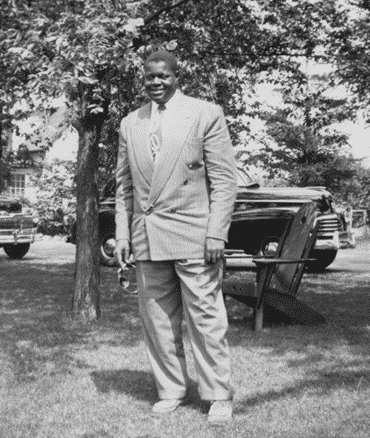
 In 1925, the same year that the United Church was founded, a baby was born to immigrant parents in Montreal.  Not terribly unusual, it was a big family, and there were already three other children and there would soon be a fifth.  The baby’s father was a porter on the railways and would regularly travel from Montreal to Vancouver for the princely sum of $90 a month.  The mother earned $5 a month as a housemaid.  It was barely enough to make ends meet, and many times the children stayed in bed because their parents hoped they would sleep through their hunger.  They were one of the poorest families in the neighborhood.

But that poverty did not define who they were.   They were committed to two things; Union United Church, the oldest Black United Church in Canada, founded in 1907, and music.  Every Sunday they would go to church, sing the hymns and play in the community band.  The dad had taught himself to play the piano and to read music and he was determined to teach every child the same thing.  As soon as the older kids were good enough, they became the teachers of the younger ones.  Hymns and classical music were what they learned, and woe betide the child who didn’t practise their scales!  They started lessons when they were three years old and big enough to sit at the piano. The oldest daughter became so good at teaching her younger siblings that she eventually made a living as a piano teacher.  Music gave her the freedom to leave the hard work of being a maid, to the hard work of inspiring young people to make music.  But that fourth baby was very special.  He could play a song that his older brothers and sisters struggled with, just by hearing it once.  He didn’t even need to see sheet music to play it.  He loved playing trumpet in the band until he got so sick with tuberculosis that he spent more than a year in hospital.  He never played trumpet again.  But then he discovered jazz!  That not only transfigured his moods and his hopes but also set the stage for his future career.

And what a career.  When he was fifteen, his older sister took him to the CBC radio station without telling him why.  She had registered him in an audition for a contest which had performers much older than him trying out.  He passed the audition, and won the contest against not just all the Montreal performers, but all Canadian musicians as well!  By the time he was 20, he performed to a sold-out crowd in Toronto’s Massey Hall, and by the time he was 24, he performed in Carnegie Hall.

He also struggled.  Barbers in Hamilton refused to cut his hair because he was African Canadian.  A white teacher in his elementary school called him racist names.  One of the bands he played in was banned from a Montreal hotel because he was their pianist.  When he became famous after his Carnegie Hall debut, he went on tour in the United States, and discovered that in the southern states, restaurants wouldn’t serve him, hotels wouldn’t let him stay with the rest of the musicians, and once the room he slept in had no bathroom but only a bucket of sand for a toilet.  With so much hatred targeted at him, he delt with the stress as best he could, remaining the polite Canadian he had been taught to be by his family and his church.  It was while on one of those tours that he was encouraged to write a new piece of music with a bluesy feel to it.  He called it “Hymn to Freedom” and it became the unofficial anthem of the Civil Rights Movement. A Canadian Song!

Now, I don’t know about you, but freedom has become an uncomfortable word in recent days.  It has been used to promote an extreme agenda, and equates temporary measures put in place for the common good of the community with oppression and dictatorship.  It was used to shut down awkward questions, and to accuse people who have differing opinions as being pawns in a supposedly increasingly totalitarian state.  It was being used to justify an individual’s desire to do whatever they want.  But freedom is not supposed to be a weapon to shut down dialogue, nor is it supposed to be a justification of behavior that ignores peace, order and good governance, our founding constitutional principles. 

Freedom means many things to many people.  Now we are reclaiming that meaning as we watch and pray over friends, relatives and kin in the Ukraine and surrounding Slavic countries.  Slovakia, the homeland of my grandparents, aunties and uncles, is also in danger as refugees stream across its borders.  When I visited as a child, there were secret police in every village, army soldiers in every street, and art of Lenin everywhere one looked.  Freedom was not part of the constitution.  Everything was controlled by the state and those in power.

Freedom, for our musician friend was seen as the precious and transforming principle for a whole nation.  He could have been targeted for vigilante violence by drinking at the wrong public water fountain, but his music inspired folks living with systemic, widespread and brutal racism to have hope.  His music transformed them as it had transformed him.  Just as God transformed Jesus on the mountaintop, revealing him as someone who was even more powerful and inspiring than the disciples guessed. Both men, Jesus and Oscar Peterson, knew that transforming the world so more people would know true freedom, would be hard work.  Both men worked hard for it even though they knew they wouldn’t see it come true in their lifetimes.  Both were determined to make a difference in this world, no matter the sacrifice, the personal cost.  For Jesus, it cost him his life, for Oscar, his personal life was a mess, and his physical health was not great either.  But he left an amazing legacy.  I found his piano course in a music store in New York, of all places.  He started music schools and taught the next generation how to play jazz and Bach both.  He challenged racist commercials on CBC.  He encouraged musicians to join AA and give up drugs.

And yet, when the top two jazz musicians in the world worthy of being mentioned in the Alberta government’s first draft music curriculum for Grade Six were announced, one was Glen Miller of “In the Mood” fame, and the other?  Not Oscar, not even local musician Tommy Banks, but Mart Kenny who didn’t even live in Alberta, and only recorded two records to Oscar’s 200 recordings spanning over 60 years, 7 Grammy awards and the first Canadian pianist to receive the Glenn Gould prize for music, not to mention the Order of Canada.  Mart Kenny’s biggest claim to fame other than the song “When I Get Back to Calgary” was being the grandfather of our current premier.  Both musicians were white, and we all know that many of the best jazz musicians were and are people of color.  So, racism is still here in Canada, sometimes subtly as in our curriculum, sometimes blatantly as demonstrated by some of the protesters in Ottawa, or regularly as related by Albertan United Church clergy of color.  And we are called to be as determined as Jesus, and as committed as Oscar Peterson, to use our privilege to challenge racism wherever we see it.  Black History month is a call to transfigure our awareness so that one day everyone will sing a song of freedom that will be true for all in the world.