January 11, 2022

Taking the Plunge

One of the joys of living in Athabasca is being able to walk along flowing water.  Being so close to the river and the creek is just wonderful, at least when it’s not -30.  We see all kinds of wildlife like the beaver in this photo, and while I’m glad not to have had a close encounter with a bear or a moose on the trails, Tim has.  I’ll stick to beaver spotting at a respectful distance.

I was surprised to learn that the Jordan River is not a grand wide river like the Athabasca.  At the place where John the Baptist was supposed to have set up shop, it’s slower and shallower than that, more like the Tawatina where it goes under the bridge during the spring.  Slow and steady.  Waist deep.  Muddy brown and probably quite refreshing on a hot day.  And a place of great significance even back then.   It wasn’t the size that mattered, it was the sense that this was the boundary between the land of outcasts and wanderers and the Promised Land.  The boundary between poverty and prosperity, between nomadic uncertainty and settled roots, between disconnection and identity, between chaos and purpose.  For the people of the Holy Land, it defined who was ‘us’ and who were ‘they’.  It was a natural border that became the difference between away and home.

A place to wash off foreign influences and prepare to enter the Holy Land, set apart by God for the people of Israel.  A place to prepare to go to the Holy of Holies, the Temple of Jerusalem, a few days' walk away.  A place to start new initiatives, new projects, new lives. 

No wonder John set up there, and that Jesus met him there.  It was full of scriptural importance for the people as well as symbolic importance, and a great place to make great commitments. We pick a time for new resolutions, but they had a place.  A humble, muddy river with a deep history for a frequently embattled community.  A place of hope, new beginnings and new possibilities.

How does that understanding of baptism in the Jordan affect the story of the Samarian baptisms?

The disciples, no longer able to sit at the foot of their teacher Jesus, are still safely ensconced in Jerusalem, hunkered down, and waiting for Saul of Tarsus to get tired of persecuting them.  They are focused on their own people, and remembering what Jesus taught them.  They start delegating work to others, and so Phillip the Deacon went out into the wider world, doing far more than he had been asked.  He found his way into Samaria, preaching and baptizing as he went, finding great success.  He followed the nudging of the Spirit and found himself far beyond Jerusalem, far beyond the Jordan River. 

He found himself outside his cultural community, with people who talked a little differently, who worshipped a little differently, who had a different cultural identity than him.  All those differences didn’t stop him.  Not even the attention of a shyster snake oil salesman in the town, Simon the Magician, deterred him.

Phillip kept on teaching and preaching.  And that got the 12 hiding safely in Jerusalem so curious that Peter and John left to check it out.  They weren’t there to fix or correct or advise Phillip, just to see if the reports were true and to encourage him.  They only were puzzled by why the Spirit had not been included in the baptism, a bit confusing even by our standards, but whatever they did or said to Phillip, he was emboldened to continue preaching and baptizing.  The next chapter is all about his encounter with the Ethiopian Eunuch and that was a transformative moment full of Spirit in the fledgling church.  Clearly, the message of good news was spreading beyond safe cultures, safe borders, safe languages, and catching fire amongst people that the 12 did not predict.  It surprised them and encouraged them.  It reminded them of their own baptisms, and the times that they had experienced with Jesus because of it.  It emboldened all twelve to eventually leave Jerusalem, ending in places like Rome, Spain, India and Turkey, far from the safety and security of the Jordan River.  Remembering their baptism gave them the courage to go out and live what Jesus taught.

Remembering our baptisms is not something everyone can do.  I was baptized as an infant, so I don’t remember what it was like.  But I remember my brother’s baptism, my children’s baptisms, my husband’s baptism and the baptisms I have done here among you, from seven-year-old Sidney and baby Emilie and  toddler Isla to adults Bev, Heather, Gordon, and Wendy, which I thoroughly enjoyed getting wet!  Every time we gather in community to celebrate and welcome another soul into God’s big family, I get a speck of something in my eye.  Every time we get to bless an individual and their spiritual journey and hear what a difference we have made in their lives, I get a lump in my throat.  I remember OUR baptisms!

Baptism is where we learn that Christianity isn’t just a philosophy, it isn’t just a logical bunch of ideas that stick.  It isn’t just a bunch of mumbo jumbo touchy feelie stuff that anyone can do.  It isn’t for sale, as the magician Simon discovered the hard way.  It’s more than community, although it’s part of community.  It’s more than miracles and signs, which surprisingly I have heard a few here in my time.  Christianity is an experience and a movement that empowers many.  It gives life and purpose to those who are struggling, it gives compassion to those who believe that they have to be tough individuals to be successful.  It challenges the magicians looking for power to rethink their understanding of what it means to be a thriving human being.  It challenges us all to reflect and reorient our lives towards God’s loving community.

Try this experiment the next time you are in the shower, the bath or even washing your hands.  Take a moment to feel the water and say to yourself a few times, “Remember your baptism”.  Reflect on how far your journey has brought you and ask God where you might be called like Phillip, Peter and John, to set out into the unknown with good news for all to hear.  Remember the nurturing, sustaining, and transforming power of God’s love and our grateful response to that gift of God, that amazing grace.  Remember that you are gifted, called and chosen by God to inspire and empower the people around you.  And if you are not baptized, I invite you to prayerfully consider it as a sign of hope and inclusion in this community of faith.  It is the sign of a journey, an adventure that leads us all in surprising new directions with a community that stretches all the way back to Jesus and John standing in a modest river, starting something that became bigger than their wildest dreams.  May our baptisms, past, present and future be part of God’s great plan for a beautiful world.  Amen.

January 04, 2022

Eyes on the Stars

There’s something so inspiring in the story of the Magi.  Following a star on a long journey that must have taken years to complete, one step ahead of another without a map or invitation.  On a hunch that they got from staring up at the sky.  Pretty amazing.  There must have been times when they felt tired, discouraged, maybe even doubtful or depressed, and yet they continued on. 

I felt discouraged this week, as Council discussed closing the church to in person worship again.  We have always put the health of the congregation as our top priority and been prudent and cautious.  But there was a part of me that selfishly wanted to keep seeing people in the sanctuary to talk to and worship with.  Thank goodness that we work together to come up with the difficult decisions that are for the greatest good of the community.  I imagine that the magi also faced similar conversations and conundrums, especially when debating how to return home.  It would have been easier to take a familiar path back, be treated like royalty in Herod’s palace, perhaps soaking in a hot tub to get rid of the smell of the manger and the sheep and cows.  Instead, they heeded that niggling voice that suggested they turn off the beaten path and skip Jerusalem on the way home.

It’s hard to know when to heed that niggling voice and when to ignore that voice.  Christians call this discernment, and it’s not easy.  We sometimes talk ourselves into doing something we shouldn’t, or talk ourselves out of doing something we should, and it’s hard to tell what is ego talking and what is God talking.  There have been times when we talk ourselves into doing things and regret it, and other times when we discover that our hunches have been very helpful.

I once got a gift of a simple notebook that someone had taken the time to fill with inspirational quotes but left plenty of room to add my own quotes to it as I found them.  She doodled and copied and scrapbooked probably 30-40 quotes into it and I have added some every time I find a quote I want to remember.  I also started to give notebooks of quotes to folks I knew that were getting ordained.  I now have a file of quotes and prayers for ministers on my computer, so I can print them off, glue them into the notebook, hand copy the shorter ones and send it on.  Last May someone from AST was getting ordained and I got another notebook out, but for whatever reason, I kept procrastinating on putting the quotes in.  Life was busy, it went to the bottom of my to do list, and I never got around to sending it.  Last November, I finally made time to put it together and sent it off to the new minister.  Imagine my surprise when I got a hand-written card back thanking me for the perfect timing.  It had arrived in the mail just when the minister needed a little encouragement.  The quotes hit home and inspired them to remember that they were not alone.  We all need a little inspiration once in a while, and we all find inspiration from each other.  I think it’s not a coincidence that the magi traveled in a group.  Jesus said, “where two or three are gathered in my name, I am there”, and whenever I am struggling to know what is wise, I know that gathering two or three, talking to our church council or one of our committees, is the best way to come up with new solutions or ideas.  New ways of working through challenging decisions, new inspirations, new hopes and dreams.

Scripture can be like a third person in the conversation, the wise words of experience that can guide us into new paths.  It can form and shape and inspire us.  It can surprise us when we least expect it to.  I was quite surprised to see that Psalm 148, the reading we started our service with, mentioned snow and frost, for example.  I struggle with the idea that God controls the weather, as I think this cold snap is no more caused by God than the floods in BC or the heat bubbles in Alberta last summer.  If God so loved the world, it doesn’t make sense for God to punish the world, or at least Western Canada with these huge temperature swings.  Much more likely for us to be experiencing the natural consequences of global warming from too much carbon in the air than an angry God micromanaging the polar vortex.

So while we treat scripture with respect, we also recognize and wrestle with its shortcomings.  Scripture didn’t understand bacteria or viruses, scripture didn’t know about oil and gas or machines or factories.  Scripture couldn’t see through telescopes to realized that Mars and Jupiter weren’t stars but planets.  Scripture is one of our partners in the discernment conversation, but not a voice that shouts to drown out the other voices.  John Wesley, founder of the Methodist Church, firmly believed that such conversations needed to include scripture, and community wisdom, but also logic and emotion. That can be a pretty crowded conversation, to weave all these aspects into decisions.

Yet decisions made together this way can lead to great wisdom, just like the wise men taking a different route home.  Wisdom speaks to us and helps guide us into decisions that might not be popular or easy but most loving.  Wisdom can inspire wonderful new ideas and creative solutions.  Wisdom can discover new opportunities that we didn’t know about.  When we look to wisdom to inspire us, and discover wisdom among us, we can find God leading us in new exciting directions.  Our Song of Faith puts it this way, “In and with God, we can direct our lives toward right relationship with each other and with God.  We can discover our place as one strand in the web of life. We can grow in wisdom and compassion. We can recognize all people as kin. We can accept our mortality and finitude, not as a curse, but as a challenge to make our lives and choices matter.”  May we find words of wisdom and choices through discernment to make our lives matter in new and inspiring ways this year.  Amen.

December 29, 2021

The Love of Power or the Power of Love?

Well, we have made it to another Christmas.  This year it is good to have you in the building, the musicians and choir, the lights and music, as well as you at home or reading these words.  It reminds me of “How the Grinch Stole Christmas”, and that the Grinch couldn’t steal Christmas because it’s not about the stuff, the gifts or the food.  They are the side effects of the celebration, not the celebration itself.  Just as Christmas for us is not only about parties and gifts but about something more.  Something enduring.  Something that inspires us to be the best selves we can be.  Something that reminds us of the Power of Love.

There are a lot of examples of the opposite, something the Vancouver School of Theology called the love of power.  We see that in the news about last year’s attempted coup in the U.S., a chilling attack on the democratic process.  We saw that when graves were discovered on the grounds of residential schools in Canada this summer. We are seeing that in Shanghai after their elections of pro-Communist politicians. And we see that here at home in officials who have Christmas parties flaunting the rules of gathering, or that set policies around family gatherings for personal preference, regardless of what the science says.

The love of power is insidious.  It is an infection that is hard to diagnose.  It is seen in politics but also in abusive relationships, in workplaces, in parenting styles, in family gatherings, in classrooms and community organizations.  It is a hard infection to treat because we often don’t even realize we have it.

Its symptoms are hidden in microaggressions, in people rolling their eyes at someone else’s comments, or in anger bursts that are bigger than necessary.  It’s in plain sight in people who wander our stores without masks on, or in complaints to town council or school boards about masks and vaccinations.  It is in plain sight when our health care nurses in Alberta need security guards to make sure they get home safely after work.  It is seen when organizations like CBC deciding not to allow discussions on Facebook because the vitriol has become so ugly.  Sometimes it is heard, as Severna and I had the misfortune of hearing, over the phone as one person yelled and swore at another person when they thought we weren’t listening.  Power over.  From the tiny comments of “Honey, take the garbage out” when honey has already done a myriad of tasks that day, to the big actions of vandalism, like the fires in Athabasca that happened this summer.  Our world is infected with the craving to have power over someone else.

Into this world of Love of Power, Something sneaks in.  Whether you call that something the Deep Mystery, the Great Architect, the Flying Spaghetti Monster, the Spirit of Music or Art, I don’t care much, but it sneaks in to vaccinate the world with the Power of Love.  It takes a very nasty and insecure individual to feel threatened by a tiny new baby, and the people who were most infected to the Love of Power were indeed threatened.  But the people who didn’t have much power, the poor staying in a barn, the shepherds living with no fixed address, the villagers and neighbors, they felt the Power of Love.

That moment of fragile vulnerability, a tiny hand waving in the air, a set of new lungs breathing in the aroma of cows and sheep and donkeys and straw, that was a clear sign that something was up, something had changed, and the world would be a different place from that time on.

I see that power of love when I hear that first nations people are rebuilding their burnt down church in St. Theresa Point First Nation in northern Manitoba.  I see that power of love when bags of clothes are dropped off for the homeless without even being asked, and people know they will get to folks in need.  I see that when a Christmas letter with no return address comes for me and I find gift cards to A&W.  It said “because we have decided to cancel all gatherings, we would like to give you the gift cards… if you know of someone who is struggling and could use a bit of sunshine… please gift the cards to them.  We appreciate your dedication to the community.”  That’s the Power of Love.

When we come here, listen to the stories, the music, the words of glad tidings of great joy, we are choosing to be vaccinated with the Power of Love.  We get our booster shots against our most terrible infection, and we remember once again that the Power of Love continues to change lives here and now.  The Power of Love conquers all fear and is the best tiding of great joy the world has ever known.  The Power of Love continues to work in us and others whenever we ponder the Christmas Story deep in our hearts like Mary did so many years ago.  The Power of Love cures our deepest diseases and infections.  May we find hope and courage to choose that love in all we do in the days to come.  Amen.

December 14, 2021

Hamster Wheels

When my kids were little, they had pet mice.  And what those mice loved doing more than anything was run in their hamster wheels.  Because they were nocturnal, we would wake up to the noise of the mice running as fast as their little paws could carry them, sometimes with so much energy and verve that the wheel would fall over and they had to stop running.  They would be so frustrated that they would chew on their wheel.  As soon as we set it up again, they would ignore it until the next night when the whole cycle would start over.  We should have hooked a generator to that hamster wheel, it went so fast the momentum of the wheel was stronger than the mouse that was moving it. It sent them for a spin upside down and dumped them out onto their soft papered cage floor.  The mice were quite bewildered about what had happened, but they kept on running!

Sometimes it seems like I’m running in a giant hamster wheel.  Work, eat, sleep and repeat.  There’s so much to do, especially at this time of the year.  That’s typical of many people.  Except for Christmas parties thrown by British Government staff people, most of us had a much quieter Christmas than usual last year, and we’ll probably do the same this year.  Presents are mailed, visits are curtailed, and zoom calls connect us without the long drives we’re used to.  It’s like our hamster wheels have stopped turning and thrown
us out back on the ground and we’re still a little dazed by everything. Some of us have enjoyed the break, some of us are still on the wheel but just can’t seem to get up to speed, and for those who are working in the health system, they have had to run faster than ever before.  They find themselves doing the loop de loop.  The constant stress has meant that collectively our blood pressure levels are higher.  Probably because of the sticker shock we have when we go grocery shopping and realize how much the price of food has risen.  Or the grief we feel when we hear of the rise in opioid overdoses impacting mostly young people.

We are living in tough times.  Zephaniah, if you read all of the book, which is only 3 chapters long, knew similar times of harsh fear and being in survivor mode.  He called out systemic injustice and would have had no tolerance of food systems that waste billions of dollars of food every year in Canada.  He would have called out oil companies that leave orphaned wells on farmland and impact the quality of the soil we need to grow crops.  He would have called out government curriculums that teach only a colonialist version of history, and pointed out the addictions we have to shopping or Netflix or on-line bullying or drugs.  He would have called out the oppressive employment practices of big corporations.  Just like John the Baptist, coming charging out of the wilderness, filled with a passion to name the hamster wheels we are running in.

Zephaniah heard God’s promise that our shame will be turned to praise, but the shame has to be named and faced first.  It’s specific and individual.  John heard several groups of people who recognized their shame in being stuck in their hamster wheels of oppression.  But John didn’t want to just get them out of their hamster wheels, but out of their cages completely!  His advice, tailored to several different career paths, was designed to get them fired!  If a tax collector only collected what they were supposed to as part of the system of oppression that Rome imposed on all its colonies, the other tax collectors would resent it and complain to the higher authorities about being undermined.  If a soldier stopped taking bribes, the rest of the soldiers would complain that they had gone soft on the locals and was no longer enforcing Roman Rule.  Enough soldiers and tax collectors changing their attitudes to the people they were supposed to be controlling and the system would collapse.  Which eventually it did. 

We can’t escape our hamster wheels or our cages until we recognize that we are in them.  People like Zephaniah and John help us to recognize that.  It’s not until we have heard their call and ask ‘what should we do’, that the cage opens up and we can feel the joy at being able to run like a hamster as God intended.

My favorite example of this is the Sister Act movies with Whoopi Goldberg.  In Sister Act 2, she goes to an inner school where the kids are trapped in a system of oppression.  They don’t want to run like hamsters, but no one is willing to support their dreams.  Sister Mary Clarence comes in, challenges the kids to get off the hamster wheels, challenges the administrators who are intent on closing down the school, and takes the new school choir to state championships where they win the contest and save their school.

This movie was inspired by a real teacher, Iris Stevenson-McCullough, who teaches music in Los Angeles in a school predominantly attended by visible minorities.  Her choirs have risen to national prominence, performing in France and Jamaica, winning many competitions.  At one point she and many other teachers were going to be fired by the Los Angeles School Board.  She publicly spoke against the cuts, inspiring media attention and reversing the cuts.  In doing so, she also inspired the people behind Sister Act 2!  In 2014, she took her school choir to perform at the White House for the Obamas and was suspended for 4 months by the school board for doing so.  Students protested again, and she still teaches as well as leading music at her Church.  She encourages her children, like John the Baptist, to not let them get stuck in cages on hamster wheels.

What can we do?  What cages are we in?  What hamster wheels are we running around in?  Who could we be sharing a second coat with or some food with?  When we break out of our cages of shame and fear, we can feel real joy as God intended us to.  Joy comes to us all, when we answer God’s call!

December 07, 2021

Open Wide and say Awe

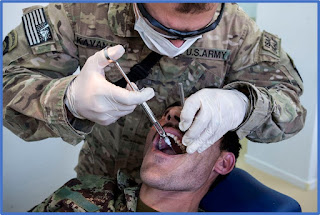
 Ever wonder if dentists are lonely people?  Do they get invited out to Christmas parties and then get shunned because no one wants to talk about their work?  Do they have a hard time dating without staring at everyone’s teeth?  Do they really expect scintillating conversations from us when their fingers and tools are in our mouths?

When I was a kid, my dentist seemed scary and rough.  He was always pulling teeth.  I inherited my small jaw from my British father, and sturdy teeth from my Slavic mother.  The British were often lampooned as having the worst teeth, crooked and looking more like a picket fence than a denture.  My teeth were so crooked I couldn’t bite into an apple!  It hurt! 

So teeth got pulled and braces were attached, and even with all that, my teeth are still a little crooked but at least I can bite an apple now without even thinking about it.  No more picket fence!  It was painful and scary, but I was always glad when the dentist would say, “you’re done, time to rinse and spit”.

Prophets were not that much different in some ways from dentists.  They, looked at the culture of the time and took some soul x rays.  Then they would say where the cavities were, where the plaque had built up, where there needed to be more flossing, and where the cavities were. 

Malachi called things as he saw them, and what he saw was rampant corruption of the religious leaders.  They were cutting corners, making excuses, and putting their own interests first.  Malachi said they offered inadequate sacrifices and weren’t providing the best spiritual experience they could.  The priests were probably coping to the best of their abilities.  They were rebuilding the temple after it had been destroyed by the Babylonians and were working with the returning refugees as well as the people who stayed after the war. Two groups of people suffering from generational post-traumatic stress. The priests tried to shape them into a coherent team that could work together in a land where things were rough and bumpy, where things were rutted and crooked.  Every shovel of dirt to clear and rebuild a farm, a road, a home, a shop, had to be done by hand.  It was a time where the worry of another invading army would have been uppermost in their minds.  Where peace was a luxury only to be dreamed of but never attained.  But the priests had gotten a little complacent, a little lackadaisical, a little sloppy.  Malachi called them to repent.

John took his call to repentance a step further.  He didn’t target the priests specifically, he called everyone.  His message wasn’t to the elite but to everyone.  Now John is a puzzling character.  When I picture him in a modern-day context, I imagine him in tatters and rags, a street person standing on a soapbox.  The surprising thing is that people actually listened to John, despite his odd eating habits and bad wardrobe.  They could see that he had lived through tough times and respected him because of it.    He must have been a tough son of a gun.  But why is he in our Advent readings?  Aren’t we supposed to be reading about angels and babies and peace and hope?  This passage sounds more like John is coming as a threat not a blessing.

Did you know that John the Baptist is mentioned in every gospel except John?  He is mentioned more than the shepherd which are only in Luke, more than Mary and Joseph, who are not in Mark, and more than the wise men who are only in Matthew.  Yet we don’t have a lovely statue of toddler John the Baptist at the manger!  John is missing from the picture of Christmas.  But we ponder his words and actions every Advent as we ponder his call to us to make things straight.

Advent is a time to do our yearly checkup and have our spiritual teeth cleaned.  Are our dentures fitting properly, do we need to floss more, why is that tooth hurting?  It’s not easy going to a Godly dentist, but just like going to an earthly one, we head off way more problems when we go regularly.  That’s what our time of self-reflection and confession is, an opportunity to reflect on our souls and scrub them before God.  Get that ungodly plaque off before we start getting cavities of our thinking and feeling.  Some people make a habit of doing this daily, through meditation or bedtime thoughts.  I journal every morning.  Some of you get a daily devotional e-mail. What do you do to keep your spirit clean and sparkly?

If Malachi is the dentist that cleans and scrapes our teeth, maybe John the Baptist does the root canals and the cavity filling.  And Jesus is the one who does the bridgework and builds the braces.

Taking my crooked teeth and making them straight was not easy, it was not cheap, it was not fast, it was not painless.  And it was not something I could do myself.  I needed a dentist and also an orthodontist.  I needed my parents to drive me to appointments.  I needed the Alberta Teacher’s Union who instituted dental plans.  I needed a good anesthetist to put me under so my impacted wisdom teeth could be extracted.  And I needed time.  I could help by brushing and flossing regularly, avoiding gum and popcorn, and getting regular checkups. 

Our spiritual help comes from God, who is calling us to partner together.  Some of us have never brushed our spiritual teeth and just coming to church is enough.  Some of us brush after spiritual sticky stuff get on our souls, a couple of times a month.  Some of us brush daily.  Some of us add floss after eating spiritual corn on the cob, and some of us are diligent at both brushing and flossing daily.  Even that does not always prevent spiritual cavities and pain, but knowing we have a good dentist to turn to when the going gets rough, helps us turn to wonder and awe at the gifts of our loving Dentist who helps us grow straight and smooth.  Thank you God, for your holy checkups that lead to peaceful souls! Amen. 

November 30, 2021

Signs of the Times


Last month we had a new addition to our congregation.  Agnes had been living in a decommissioned United Church in Collinton for several decades. She is currently 109 years old.  She was a wedding gift to Gina Payzant, the movie director who did a documentary on George Riga, author of “The Ecstasy of Rita Joe”. Agnes was gifted to Gina in 1976. The plant was sixty four years old, at that time, which means it was born in 1912.  Wow.  It must be happy here despite the indignity of being moved from its home, because it is already blooming!

Jesus might have appreciated Christmas cacti, although he would never have seen one in his homeland.  But they like to bloom every Christmas and Easter.  How do they know it’s time to get ready to do that?  Like the Fig Tree in the parable Jesus taught, (Luke 21:25–36) they know the signs of the times.  They know when the days get short and the days lengthen again.  They know what time it is.  They get ready.

The disciples were living in uncertain times, where there were no insurance companies to rebuild homes, no armies who could bring in helicopters, no way of distributing feed to livestock stranded in floods, no governments who could step in with emergency funding and infrastructure dollars.  Their time of challenge was a daily lived experience.  So it must have been confusing to hear that when the signs were troubling, nations were in turmoil and when danger was imminent, they were to stand up straight and raise their heads.

Why? Because Jesus would return for them, and return in love amidst the violence, the troubles, the signs.  They could be comforted in the knowledge that they could stand secure.  Unlike their neighbors and friends, they would be able to rise above the worry and the indulgences, staying calm and resourceful, being patient and brave.

How?  By remembering that God was with them.  If someone like Paul, who was flawed and bad-tempered, impulsive and antagonistic, could write so lovingly to the Thessalonians, how much more assured would the disciples have been by what Jesus said?

The signs of our times have been dire.  I feel for the churches in BC preaching on this scripture.  Between fires, floods, heat bubbles, mudslides and Covid, they must feel like the end times are real and are here and now.  People ask me if I think the end of the World is at hand, and if the second coming is near.  But if we read the scriptures carefully, we hear that Jesus taught the end was happening in his follower’s lives.  “This generation will not pass away,” he said, and we see echoes of that immediate expectation in Paul’s writings as well as in the other gospels.  In fact one of the hard things the early church had to wrestle with was that Jesus didn’t appear on schedule and people started dying before the Second Coming.  They had to change and adapt their expectations while they waited.  It’s one thing to sell all your possessions and share what you have with your neighbors when you think there’s only weeks left, but another thing when the weeks turn into months and the months turn into years.  Paul wrote a lot about that, and the transition was hard.  That’s why the gospels were written down, as the first witnesses to Jesus were executed or died.  Our scriptures that we read every Sunday morning are the legacy of that shift in thinking.  The end times did not come when they were expected, but the people changed their focus from waiting for immediate results to waiting with alert readiness.

Our world ends all the time.  My world first ended when I was 10 and my 4-year-old sister died about a month before Christmas.  My world ended when I gave up on church, deciding that God was dead and worship was meaningless.  My world ended when the cute boy told me he was not interested in me as anything more than a friend, and I knew I would never get married or have kids.  My world ended when I got the phone call from the hospital that my dad finally died from cancer.  My world ended when I heard the words, “your son has been in a motorcycle accident.”

But our world begins anew all the time too.  When I was twelve and the day after my birthday, I had a new baby brother to love.  When I heard the words, “welcome to our church, we hope you find God as you worship with us.” When Tim asked me to marry him.  When I twice had a new baby put in my arms and I marvelled at their tiny little toes and fingers.  When I watched them graduate.  When the phone call about the motorcycle accident added, “but he’s okay and is very lucky.”  When I graduated first from Education then from ministry.  When I was welcomed here and told, “we’re happy to have you!”

When our worlds end, we are to stand up straight, lift up our heads and rejoice because our salvation has come.  Remember Gandolf when he faced the monster in the mines of Moria?  He stood up tall, made a  cross with his sword and staff, looked the fiery Balrog in the eye and said, “You Shall Not Pass” with a blaze of light!  

When we see signs around us that we live in troubled times, let us not look for hope, let us be the hope!  Like Agnes here who lived through the War to end all Wars, the Spanish Flu, the Cuban Missile Crisis, Y2K, the Twin Towers and more, yet keeps blooming as a sign of hope and beauty.

Usually the first Sunday of Advent, I tell stories of where to find hope, but not this year.  Together, let us be signs of hope that the world so desperately needs.  Stand tall, look trouble in the eye, and shine your light of Christ so all can see! We can do this because we are blessed with the love that binds us together in one great community of saints that traces back to the disciples and Thessalonians who stood tall for us so we can stand tall for others!  And may God be our blessing and our salvation in these times.  Amen. 


November 16, 2021

When dreams are in ruins

Doomsday.  It’s like a car crash on the Anthony Henday freeway.  We slow down to watch the disaster or because the emergency response vehicles are flashing their lights, and it’s hard not to rubberneck as we crawl by.  Or it’s like hearing about a tornado and power outage in Vancouver.  I immediately texted my son only to find out he had not even known that the power was out for some of his coworkers.  Or like the time we were on our honeymoon in Queensland in 1987 and heard that Mill Woods, where our brothers lived and our wedding presents awaited our return, had been destroyed by a tornado!  Time stands still for a moment, disbelief is expressed, adrenalin kicks in and we do what we can to connect with our family and friends.  Our home in Mill Woods didn’t even lose a leaf off a tree that day.  But the anxiety that we endured while we scrambled to find out what had happened took a while to wear off, and we were lucky compared to some folks in the trailer park.

Now we are in times that have left many feeling anxious and isolated.  It feels like we are all holding our breaths waiting for things to go back to the way they were.  Yet so much has happened and is still happening that it is hard to picture what back to normal, or forward to new normal, will look like.

Mark was writing his gospel at a similar time of great change.  He remembered the ‘good old days’ when Jesus was teaching the disciples, inspiring, empowering and engaging them.  The times Jesus comforted them, the times Jesus provoked them.  When we hear Mark’s story, there is a lot of Jesus provoking and challenging everyone he met.  The scribes and Pharisees, the temple officials, the keepers of the status quo.  And he provoked his disciples too, much to their discomfort.  Imagine standing in a beautiful, awe-inspiring building that was the centre of the faith, and Jesus saying, eh, it’s not so great.  And Jesus was right to warn them not to worship the building.  Only 30 or so years later, it was destroyed so badly by the besieging Roman army that it would never be rebuilt and the western wall is all that’s left of what was once a glorious symbol of Herod’s ambitions.

The trauma of having the temple, with the holy of holies destroyed alongside much of the city, was devastating for the faithful.  They struggled to understand why God had allowed it to be destroyed.  Leading up to this, charismatic leaders were recruiting people to wage war on the Romans.  They had some success and wiped out 6000 Roman Centurions in one ambush.  But as the Romans started taking the insurrection more seriously, pushing the various groups into Jerusalem, the leaders started fighting amongst each other in a bloody civil war.  Jerusalem was destroyed, with a death toll of over a million, according to the Roman Historian Josephus.  So Jesus warning his people of the different leaders who would be vying for their loyalty was making an important point.  Jumping on a bandwagon because it’s led by a charismatic speaker is not what God is calling us to do.  It can lead to death and destruction.  The world is full of earthquakes and wars and famine, but we are not to be dismayed.  We are to stay focused on our purpose.

I am proud of this congregation.  We have been very steady in our focus.  When DJs urged us to protest public health legislation, we did not jump on that bandwagon.  When friends and family started sharing conspiracy theories or recommended veterinarian medication for Covid, we resisted.  When people thought it was okay to make racist comments in public and talk about making Alberta great again, we challenged those attitudes.  We wore orange feathers and orange t-shirts, we wrote letters to the editors, we started petitions to save parks, and other initiatives.  We started saying a land acknowledgement long before it was popular to do so.  I was surprised and impressed that the Remembrance Day ceremony this week started with a land acknowledgement.

Here are two stories from this week of how we  make a difference when we stick to our vision of God’s Community.  One was a family of four who came because the Friendship Centre thought we might have some winter coats to give them.  There was an eight-year-old, a mum, an auntie and a kookum, and they told me that Covid had been a real struggle for them.  They saw our basket of socks and their eyes opened wide and they were so happy to know that they could take some home.  They also took some of the food and clothes from our donation baskets.  Next time they come they will take our Jiggs Dinner that we froze for families in need.  There were other people who were treated to new socks and food this week.  People struggling with mental health or with developmental challenges.  But I will not forget the look on the RCMP officer’s face who came to collect socks for the Detachment.  I told him we had a lot, but I don’t think he believed me; he told me he’d take as many as we could spare.  Boy, was he surprised with the basket filled to overflowing!  He said that socks would go out in the squad cars so that if they had to deal with someone who was in the bush, they would have warm dry feet because of us.  And he wanted me to thank you for your generosity.

We may help prevent frostbite, gangrene, or even death amongst people who have lost hope that they deserve to be treated with care and respect.  Paul wrote, “provoke one another to love and good deeds”, and we have done just that.  Having a vision that stays the course, inspires generosity, empowers our community and engages the ones who are seen as least among us, is what we as Christians are called to do.  When we keep that vision in mind, walls are broken down, chains are thrown aside, and we all live in Christ’s vision of freedom and liberty for all.