August 30, 2022

Where to Sit?

 How many people remember playing musical chairs?  How did it go?  There would be a circle of chairs and there would always be one less chair than there were kids.  We would circle around the chairs until the music stopped then everyone would rush to sit on the nearest chair.  The person who was left standing was eliminated from the circle, another chair was removed and we would do it again until there was only one chair left.  How many of you remember winning?  How many of you remember having to wait a long time on the sideline until it was time to start again?  What did it feel like to win?  What did it feel like to be eliminated?

I don’t ever remember being the winner, although I think I made it to three chairs once.  Winning is not something that we humble Christians are supposed to intentionally go aggressively after.  And maybe that’s why the Christian message has fallen out of favor; it’s not about winning at life against all adversity, or being the best and lording it over all the other contestants.  I know I am a dreadful competitor, I really want to win. Last spring I was in several contests for Toastmasters, and finding my way into a humble mindset was really difficult.  I didn’t like how competative I became, or even entitled and selfish I felt.  In the end I reminded myself that I was doing it for fun. 

So much of life can become a competition.  Where we sit at a banquet can certainly be a part of that.  How close to the bridal party will we get to sit?  Where will our table be at the Rotary Dinner or the Chamber of Commerce awards night? What about the AU President’s Breakfast or the Mayor’s Lunch? Who will we sit beside at the Senior’s pancake breakfast?

They can be ways we measure our status and importance to other people.  That’s what Jesus saw when he was invited to dinner one evening.  He probably was remembering Proverbs 25:6-7, which says “Do not put yourself forward in the king’s presence or stand in the place of the great; for it is better to be told, “Come up here,” than to be put lower in the presence of a noble.”  Wise words from the scriptures that he saw in action that day.  Here he was, guest of a pharisee, invited for supper and the nerve he had, reminding them that scripture taught not to be pushy and aggressive.  Not to treat dinner like a game of musical chairs, where you try to win status and importance before everyone else.

I suspect some of you might be saying, “So what?  I’m not going out to dinner parties with famous movie stars or politicians.  I’m not dining with the rich and famous these days.  Even before Covid, I didn’t do that.”

We might not be dining or hobnobbing with important people, but I dare say we may still feel the itch to prove ourselves as worthy or important or influential.  We may feel like we are entitled to being treated as the special individuals that we hope we are.  When I talk to hairdressers, they tell me that the clients who can be demanding and finicky are even more demanding and finicky since Covid.  We hear stories of the ‘mass resignation’ of people in the restaurant and retail industries because they are fed up with being treated like servants to be ordered about.  Others are doing what they are calling a ‘silent resignation’ where they stop going above and beyond in doing their jobs.  No more overtime, no more working through lunchbreaks to prove that they are committed to the company, that’s not happening anymore.  About 24% of employees think that their bosses care for them, which means that most working people feel their bosses don’t care at all.  Getting to be at home for folks meant a break from the hustle, the harassment, the watercooler gossip sessions, the entitled customers.  And they don’t want to go back.

It sounds like they are tired of playing the adult version of musical chairs! Yet it’s easier said than done.  We may be thinking that we’re entitled to more respect than we actually are.  Like the average driver who thinks that they are above average in their driving skills, we may assume that we are better than others because we are us!

Jesus taught us that the game of musical chairs is not what God wants us to play.  This game assumes that there’s scarcity we must compete for, including scarcity of influence. Jesus said our seeking importance can become an idol.  In our craving for status, we can be actually embracing fear, fear of others, fear of the unknown, fear of our own ability to deal with life’s challenges. 

How do we let go of this game of musical chairs? Our reading from Hebrews suggest we do it through worship, community, ministry of hospitality.  We do it through sexual relationships that are not competitive or dominating, and through money decisions free from status seeking and influence peddling.  Perhaps donating to a charity instead of buying a vote. Remembering that God is with us, we shall not be afraid, what can mere humans do to us?  Nothing can separate us from God who loves us, not even our seating arrangement and we sit beside.

Someone wrote: If you are sitting in public and a stranger sits down beside you, simply stare straight ahead and say, “did you bring the money?” Christians have a reputation of saying to strangers, “that’s my pew” or “that’s my chair.” God calls us to say instead, “come sit with me and be welcome in this pew”.

The Kingdom of Heaven is like a game of musical chairs where the music never stops, the chairs face inward so we can see each other and there are always enough chairs for everyone. Thanks be to God for this blessing.

July 26, 2022

Travelling light

The other day, I discovered a beautiful little nest sitting on my newly cut lawn (pictured here to the left). It looked like the adult birds had carefully built it right there and never used it. No eggshells, no feathers. It didn't even look like it had fallen from a tree. Perfect example of amazing architectural design then abandoned to the elements. Birds travel lightly, and do not hang onto their homes. 

Given the chaotic state of airports these days, we can't say the same. Stories of lost luggage and cancelled flights are filling our news feeds and people describe the trauma this has caused them. I had a family member travel to New York one year who lost their luggage and never again will they put all their prescriptions in their checked suitcases! We don't know how to travel lightly. Unlike the birds. 

Paul wants us to travel through life with at a light heart. He wants us to focus on dressing ourselves with peace and love and joy. And part of learning how to dress ourselves in that kind of Sunday best is by singing and praying and building community to get safety. Rather like a nest, we are woven into a place of safety that holds fragile beings growing in their ability to take themselves lightly.

I meet so many people living heavy lives of fear and resentment.  They don’t have a safe space, and they don’t know that they need a safe space for learning to live more lightly.  Often when they find out what I do for a living, they tell me how they left the church and the stories are full of anger and self-righteousness.  It’s like they are saying, “See?  That church was full of mean toxic people who hurt me.  I was right in leaving and I am right in staying away.”

Which is a heavy mindset.  It is stuck in fear, it is stuck in independence and self-protection.  Sure, there are times we should walk away from toxic situations.  And there are churches and groups and communities that people need to leave because they are toxic.

I get it.  We don’t get through life without getting hurt by others, and we don’t get through life without occasionally hurting others, sometimes accidentally, sometimes with good intentions.

But.  That doesn’t help us travel lightly.  All too often people who have turned their backs on church haven’t worked through the anger and fear that life event triggered in them.  They get stuck in resentment and anger.

They remember and retell the hurts over and over.  Psychologists are discovering that when we tell and retell our trauma stories, there comes a point where it is no longer healing but can retraumatize us.  It becomes a trigger for the same fight or flight adrenaline rush that we felt when the incident first happened. It entrenches our anger and self-righteousness. What if we experimented with forgiveness instead?

Both Paul and Jesus talked many times about the feeling of lightness that comes from forgiveness. We are supposed to forgive 70 times 7 and pray for our enemies.  That’s not easy.  Some think it’s about having positive feelings and thoughts about the person we feel wronged by, which I think is unrealistic.  Others talk about the legal interpretation, which is giving up all claims to exacting punishment for transgressions, but we need justice and accountability in our world.  I think that forgiveness can be choosing to let go of the retelling of our trauma stories in ways that hurt us.  And learn how to strengthen ourselves to being more Christlike, with that heartfelt compassion, kindness, humility, gentleness, and patience Paul talked about.  It doesn’t mean becoming doormats.  It does mean letting go of our resentment of the person not being better than they are, situations not being perfect, and justice not being always fair.

Holding grudges, hanging on to old stories of grief and injustice, can be like a rock we put in a backpack.  Every time we look at that rock, it gets a little heavier.  If we start collecting more and more rocks and seeing every little incident as a rock we can’t forget, our backpack gets continually heavier until all we can think about is that backpack and we can’t move an inch.

Jesus invites us to take a rock out of our backpack, say thank you for the learning you gave me, then set it aside.  Start small and work our way up.  Start with the person who drove through that stop sign in a hurry or grabbed the last package of bargain-priced pizza from the store shelf.  The bigger rocks that are really heavy may need help, get the lawyer, go to Together Talk or counselling.  The hardest rocks may be about me – how do I forgive myself for being duped by that scam caller, that con artist on my computer, that stupid mistake I do over and over?  Or bigger yet, how do I forgive God for the tragedy in my life?

Yes, sometimes we need to figure out how to forgive God.  Maybe not for giving us that pony we prayed for, like Robbie did, but for the more serious problems.  As far back as 1942 George Buttrick wrote about forgiving God this way: "If God is not, and the life of man poor, solitary, nasty, brutish and short, prayer is the veriest self-deceit. If God is, yet is known only as vague rumor and dark coercion, prayer is whimpering folly... But if God is in some deep and eternal sense like Jesus, friendship with God is our first concern, worthiest art, best resource and sublimest joy."  Calling God loving parent, as Jesus taught, helps us forgive even that toxic image we have of God.

Forgive us our trespasses as we forgive those who trespass against us is only one part of the Lord’s prayer.  May we pray it with persistence, humbleness and intentionality.  And may we let go of all that weighs us down until we travel through life as lightly as birds. Amen.


July 19, 2022

Swords and Dishes


Ever been embarrassed in public by a family member?  I will never forget the day someone in my family asked my cousins how to teach me to dress properly.  I’m sure I turned bright red with embarrassment.  I couldn’t have been more than 6 or 8 years old, but that incident stuck in my memory.  

Family gatherings can be like that.  “Can you tell so and so how they should behave?” can sound like an innocent comment but is really an attempt to shame the other person in public.  How embarrassing it is to hear that.  It is also very common.

Which is why the Mary and Martha story is so relatable.  It sounds like a typical argument between two sisters.  I imagine that Martha was the first-born child, used to acting in a parental role, taking charge and making sure everything got done just right.  And Mary was the youngest child who got spoiled by doting parents and was not good at the practical aspects of day-to-day living.

It came to a head when Jesus showed up for a visit. Martha was determined to show good hospitality.  That was a core value of her faith.  Stories going back as far as Abraham and Sarah taught about the importance of hospitality.  Without hospitality, being a wanderer in the wilderness could easily lead to starvation and even death.  But Martha was also focused on herself and her tasks.  She mentioned herself several times, “My sister, me, and me.”  The only thing she wanted Jesus to do was join her side and use his authority to correct her sister’s inappropriate behavior.  And she claimed Jesus was being uncaring, hoping to get him to take her side.  This is classic manipulation and triangulation.  Trying to get a third party to do the communication that she would not have with her sister.  Some psychologists would go even further and describe this as bullying behavior.

It's subtle bullying that leaves the target feeling shamed and embarrassed and uncertain how to react.  Mary never said a word in her defense, she might have been as shocked and ashamed as I was at my family gathering.  Words like these can leave us speechless!

We have no idea of why Mary did what she did leading up to Martha’s comments.  Was she rebelling against Martha’s expectations, deliberately sitting down with the men, and daring Martha to complain?  Was she putting Jesus on the spot by acting like an equal to the disciples?  Or was she just mesmerized by what he was saying, forgetting what she should be doing and dropping everything to sit and listen? 

Even today, the Marys and Marthas of the world can experience deep shame around housekeeping and expectations.  If you watched the CBC show “Back in Time for Dinner”, you may remember the mother saying that the 1950’s with its expectations of domestic perfection made it the worst decade for women.  And there is still a lot of shaming around housework.  This week I read, “How to Keep House While Drowning” by KC Davis.  She is a psychologist and a mother of two; the youngest was born during Covid lockdowns.  She struggled with post partum depression with her first, so wanted to prevent that by having a friend help with cleaning, other moms with babysitting swaps and so on.  All that fell apart when Covid struck.  And when she shared how she was doing, she was told that she was lazy because she didn’t get the dishes and laundry done every day.  There was no sympathy for living with depression or mental illness.  So, she wrote a book about housekeeping and talked about the outer messages that fed her inner bully. It lives in our heads and can be louder than real people because it doesn’t stop. It can trigger depression, anxiety, and shame.  That inner bully which sounds a lot like Martha, can leave us vulnerable to mental illness. 

And lest we think this is a problem that only women face, there’s a wonderful book called “Becoming the Kind Father” by Calvin Sandborn.  He also writes about the inner bully who shames men for showing emotion, vulnerability, gentleness, or any number of things our society has decided men shouldn’t be.   That toxic idea is probably what led to the sword attack we heard about in Athabasca this week.  Both Sandborn, Davis and others like Brene Brown write about how destructive the inner bully is. 

Comments like “Tell my son he shouldn’t cry”, or as in today’s scripture, “tell my sister she should be helping me in the kitchen” feed the inner bully until it destroys souls, families, and marriages.

Jesus says to all of us, “You are anxious about many things.   But it’s time to quiet the inner bully and love yourself and your family instead of feeding shame and blame.

We are called as Christians to convert our inner bully to an inner Christ.  A gentle, loving voice that changes shame and blame words into love and support.  It takes time, but it is possible.  We do that when we admit that we are not perfect, that we feel overwhelmed at times by all we feel pressured to be and do.  Martha was called to be hospitable, but not to the point that she forgot the love she had for Mary.  Her sister was called to learn from Jesus, but not to the point that she neglected her sister.  Both were called to listen to Jesus’ message to love each other, pray for each other and not to lose track of their relationship with him.  We too are called to listen to Jesus’ message of love and compassion.  It’s why we say a prayer of confession and hear words of comfort and assurance on Sundays, to calm our inner bullies. When we replace those inner bullies with Christ’s peaceful, loving words and vision, we can heal ourselves and our world.  May it be so for us all.


July 12, 2022

Testing Jesus

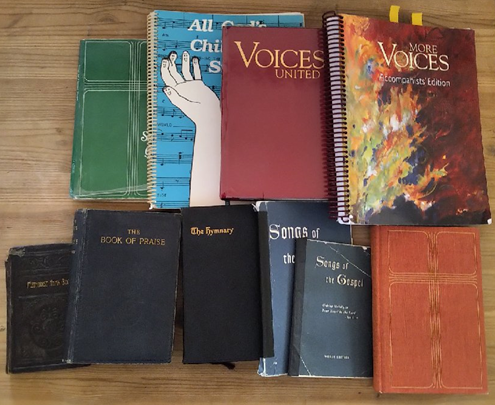
One of the things I seem to be accumulating is a collection of hymn books.  I have the red hymnbook from the 1970’s, the green hymn book from the 90’s, Voices United and More Voices.  I even have the 1950’s Songs of the Gospel which was the first hymn book I ever sang from as a child.  And now that I’m on a subcommittee helping with the new hymn book with over a thousand submissions we’re wading through, I’m very aware of the hard work that goes into putting it together.  And how much compromise and testing goes into selecting hymns. And how no matter how hard we work, there will be someone unhappy with the decisions that were made. 

Cecile passed on this little gem to me (pictured on the right here) when they were getting packed up for their move.  It is a Methodist hymnbook, (Methodists were part of our founding congregations, where we get the dove in our crest), and the preface described the need for a hymn book for the newly amalgamated Methodist Church of Canada of 1874, between the Wesleyan Methodists and the Methodist New Connexion of Canada. They wanted a Canadian hymnbook that would unify them in song.

But there’s something about hymn books that have the critics hunting for all the problems they can find.  When Voices United came out, I went through the Green Hymnbook to see which were kept and which were included.  There were a few, like “Give me Oil in my Lamp” that I was surprised didn’t make it.  So, it was amusing to see someone wrote in this old copy, “Why omit Charles Wesley’s ‘Rejoice the Lord is King?’”

Testing the decisions of the hymn committee.  We do that.  We test.  We challenge.  We question, especially anything that is new.  Maybe because we are in a grumpy mood, or because we have a level of expertise that is higher than what we think the other person has. Or because we have an idea worth contributing.  Or because we are coming from a less than humble attitude of superiority.  Or because we find someone else’s idea threatening.  Or even worse, because we find that person themself threatening.

The lawyer felt threatened by Jesus’ new approach.  Maybe he distrusted the charisma or the leadership skills, the new ideas or the sense of authority or the growth of new disciples and followers.  Maybe he had a toothache that day, or his supper hadn’t agreed with him.  Regardless, he didn’t like what Jesus was doing, and he was determined to test Jesus.

So Jesus pulled out a story that has become so famous that as soon as we hear the words “Good Samaritan”, we know it.  Folks who have never heard the story may still know the phrase, and it’s interesting that when I got my Naloxone training, I was told about the ‘Good Samaritan’ law, which was put in place so that if one addict tries to save another addict’s life from an overdose, they will not be arrested.  Good Samaritan was even used this week for a CBC story of people helping pull a man out of a burning car in Ontario. It’s a familiar phrase and there may be people who have no idea that Jesus invented it in response to being tested.

It was a shocking story, deliberately challenging the lawyer so badly that he could not answer Jesus’ question of who actually acted like a neighbor.  If Jesus was here today, the story would be about a Ukrainian civilian who was hurt in a missile strike.  A Ukrainian Orthodox priest walked by and crossed to the other side instead of taking care of the wounded civilian, then President Zelensky also walked by and again crossed to the other side.  Then a Russian soldier walking by found the Ukrainian civilian, dug them out from the rubble of what was left of their house, and carried them to the nearest hospital.  The soldier gave the hospital money for antibiotics and promised to take care of any additional expenses on their return.  The shock of the Russian being the one to help is like the scandalized lawyer’s inability to even say the word ‘Samaritan’.

Jesus tested him, "Which of these three was the neighbor?"  The lawyer answered, "The one who showed kindness."

Jesus challenged his tester to move beyond wordsmithing and legalese, logic puzzles and abstract philosophy which put following God into an intellectual exercise for abstract arguments.  Jesus wanted his tester to see the debate about defining neighbor more than mental gymnastics, but something that challenged the emotions as well as the logic.  And not only moving it from an ethical debate to an exercise in empathy, ultimately moving it into the realm of action.  As one Maritime song put it, move from the head to the heart to the hands.  How do we get our faith to move in that direction?

Someone recently joked that the difference between the Methodists and the Presbyterians is that when you tell a Methodist about a problem, they will say, “I will pray for you”.  When you tell a Presbyterian, they will say, “I will think about you.”  We who are United can combine the best of both worlds, think, pray, and see what we can do, not to take over and fix things for people which just enables them, but what we can do to empower them, help them come up with their own actions and support those actions as best we can.  Our hymns can help us do that.  When we read the words of the hymns, we engage our thinking.  When we hear the music, we engage our feelings.  When we sing the words, we engage our bodies in acting on the words and
feelings.  Test, empathize and act in compassion and love.  The more we do that, the more we become able to think of and respond to the neighbors we are called by God to love. May it be so for us all!


July 05, 2022

Sow Seeds, Trust the Promise


I love the Canada Day weekend!  Severna gets busy and starts bringing over pots and bouquets, the bedding plants are blooming and spreading, and the seeds are sprouting and growing.  This year, Severna planted lots of sunflowers as they are the symbol of Ukraine.  We know that not every seed will grow or even bloom.  I once saved the flower heads of marigolds and was surprised at how few of the seeds germinated the next spring.  Which may be why marigolds produce such an abundance of seeds in the first place.  Not like the poppies in the back yard of the church who reseed themselves prolifically. 

Tim and I planted tomato seeds back in March. We didn’t have any special starter mix, so they didn’t grow too strong or fast.  Then we bought a can of tomato soup this week and it had tomato seeds as a freebie give away stuck on the can.  It even had a link to a website on how to grow the seeds.  We might just try again with these free seeds.

We know, as all gardeners do, that if we plant tomato seeds, we won’t harvest zucchinis. We are going to reap exactly what we sow.  No exceptions. Paul knew it too.  He was the master of metaphor, something worth reminding folks who take the bible more literally than it was intended.  He knew the use of clear images was how Jesus got his teachings to stick.  And he also knew that not every seed would sprout and grow.

Jesus knew it too.  When he sent out the seventy, he gave them instructions that reminded them of this.  “Expect that some people will be open to your message and hang out with those folks.  If they aren’t open, move on. Shake even the dust off your shoes.”

In other words, when we plant our seeds, ultimately, we need to trust that some, not all of our seeds will sprout without us hovering anxiously over them day or night.  And not to take it personally if our seeds don’t grow.  This is very hard for us all.

I know I have been bombarded by people who do take their seed planting very personally.  They are not content to just plant the seed, but it’s like they take a backhoe to dig a deep pit before throwing the seed in.  Then they hover.  And watch and insist that the seed of faith sprouts as they wait.  It’s like being at a time share – ding ding, another soul saved, and you get salesman of the year award for your two hundred people brought to Christ!  Yikes!  Sounds desperate, like their own salvation is based on how many converts they can make.  And competitive. That doesn’t sound at all humble, does it?

I wonder if we are thinking about planting our seeds the wrong way.  We say things like, “You should come to church” and wonder why people get angry at that comment.  Firstly we started with “You” and topped it off with “Should”, which never sounds loving, humble or trustworthy. And Jesus didn’t tell his disciples to say that either.  They were not setting up churches or doing membership drives.  He said, “go and be with people.  Eat their food even if it’s a nasty looking guacamole that’s been in the fridge too long (okay, I wouldn’t go quite that far).  Go and be a healing presence with them.  Go and help them with their emotional challenges and mental anguish.  Not with an aim of fixing, saving, advising, or correcting them.  That is not humble.”  Jesus wanted his followers to go and love their neighbors. Help them learn to build their health and stability and resilience for themselves.  If the disciples were selling anything, it was a deeper relationship with God.  Not coming to church. Or saving souls.

Be humble.  If the residential school missionaries had come with a humble mindset, how might that have changed the course of history?  If they had come with love and compassion and listened and sat and eaten together and lived in teepees first before they built schools and farms, how much different could they have been when instituting the Indian Act?  If they had focussed on trying to empower indigenous people instead of intimidating and enculturating them, how would our truth and reconciliation needs be different today?  And if we came to everyone we met, listened first, and then did our best to be the healing presence instead of the expert, how could that have shaped the very ethos of what Canada is today?

What would happen if we never tired of doing good, planting seeds?  What if we remembered that it’s all about the love of neighbor and love of self?  What if we worked hard to root out any possible accidental weed of selfishness or superiority from every relationship?  What if we remembered that it’s not about bringing people to church but helping people connect to God? And remember that Jesus had spent time first healing and teaching his followers before he sent them out.  We may not be ready yet to heal if we have not first been healed ourselves and that’s okay. Take time to let yourself grow and sprout before you start planting.

Then let God do the rest!  Ultimately, we and God wants a world filled with people of compassion, courage and kindness.  If we can plant seeds of that for others and they can learn that from us in this church, that’s great, and I hope that’s what we are about. Our mission is to be an inspiring, engaging, empowering community that comes together to worship in all our diversity.  So let’s plant our seeds of love in confidence and courage and hope, then rejoice that God does the hard mysterious stuff of getting our seeds to turn into zucchinis, tomatoes and sunflowers. God loves us, guides us and grows us into resilient people one step at a time, in love and humbleness. May it be so for us all!

June 28, 2022

Mush!

I love watching movies! But there was one movie that I hadn’t gotten around to watching even though the dvd was sitting on my coffee table for months.  It was Call of the Wild, by Jack London and starring Harrison Ford.

I remember it being one of the first grown up books I read as a kid.  Call of the Wild is not always pleasant.  But the struggle to get dogs to pull a sleigh together is a vivid image. They go from a pack of snarling, growling individuals that snap and bite to a team that pulls together and gets everything from mail to food delivered across long stretches of cold northern territory.

The scriptures today remind me of the courage and hard work that goes into forming a dogsled team.  Jesus knew where he wanted to go, and nothing was going to steer him away from his purpose.  People who tried to get him to change course were left behind.  His fellow travelers, the team he had put together, were told in no uncertain terms that there was only one destination, and if they didn’t want to go in that same direction, they were not in the team.  The priority was on the destination, nothing else.  The destination was bigger than family connections, cultural traditions, or expectations of rewards.  The goal had to be at the centre of every decision along the way.  Even revenge on those who insulted him would not get to his goal. “Shall we rain down fire from heaven and destroy them like the prophets of old did to their enemies?"  Nope, Jesus had no patience for treating people like that, no time for violence.  He wanted his disciples to love their enemies.

He wanted team players who would pull their weight and let go of the need to be right, or the need for power or control.  To practice forgiveness of the wrongs others did and keep focused on helping people hear the good news of God’s redeeming love.

He wanted to pull people from their individual agendas into a team that could smoothly go the distance and be in it for the long haul.  Just like a dogsled team working together to travel the vast distances in the north.

Paul was focused on that too.  In his letter to the Galatians, he reminded them of the end goal they were working towards, and what stood in the way of them reaching it.  A goal of love, where everyone would know true freedom to live without anxiety, guilt, shame, resentment, depression, anger and fear. Paul’s phrase ‘Living by the flesh’ is better translated as ‘living by impulsive selfishness”, and the list of attitudes and behaviors that destroy teamwork as well as mental health is long.  Some seem odd to us today.  I’m not sure the last time I was tempted to indulge in some sorcery, for example, if I substitute superstition instead of sorcery, it has more meaning for me.  The rest, hostility, arguments, jealousy and the like certainly do tear us into pieces and keeps us all from moving forward.  Snapping at one another like dogs fighting over the lead spot in the dog team means that we are at a standstill.  The sled won’t budge and we won’t get one inch closer to Jerusalem!  But when we deal in healthy ways with conflict or selfish agendas, and substitute love and gentleness and the other fruit of the spirit, we can really get flying as a team.

How do we know we are using healthy ways?  When we have love, joy, peace, patient endurance, kindness, generosity, faithfulness, gentleness and self-control, the fruits of the spirit.  When we open ourselves to Christ’s vision, when we set our faces to Jerusalem, when we remember why we do what we do, the fruit reminds us and guides us to rise above our impulses, selfishness and self-destructive behaviors.  The fruit helps us to work together as a team and to stay focused on where we want to go.

Where are we headed?  On the road to freedom, and not just freedom for you and me, but freedom for all.  Can you imagine what it would be like to feel even a little freer from all the stress and challenge of your life?  5% less anxious about money or 5% less jealous of your partner’s friendships or coworker’s successes or neighbor’s car or family member’s vacation home or friend’s travel plans?  5% calmer, 5% more comfortable with prayer, 5% more courageous in talking about your faith? 5% more understanding of what triggers your emotions?  Now some of you who are new to our church might be thinking these are ridiculous claims, and maybe some of you who have been coming for a long time might feel the same.  But I bet if you think back to what brought you here, you might recognize a yearning to have that freedom.  And for those of us who have been here a while, if we look back to who we were a month ago, a year ago or even ten years ago, we might just be able to see that yes, we are that 5% better than we were.  I know that this congregation has helped me develop more resiliency when it came to dealing with all the craziness that Covid put us through.  I am definitely more prayerful than I was, and more focused on making our community a healthier place for all, a little closer to being the new Jerusalem that Jesus, Paul, Luke, John and more worked together to build.

The Call of the Wild was in the end a call to freedom.  We have a call to freedom too, just like Buck the sled dog.  The United Church of Canada says that we are called to be a bold, connected, evolving church of diverse, courageous, hope filled communities, united in deep spirituality, inspiring worship and daring justice. Here we say we are called to Worship, Inspire, Engage, and Empower. Together, with the Spirit, let us work as a team to journey to new ways of living with each other and the world in love and freedom.

June 21, 2022

Over, Under

 When I was a kid, the ultimate test of friendship was the teeter totter on the playground.  Unlike a swing that one person could power all by themselves, a teetertotter needed cooperation to make it work.  If you picked the right partner.

Too big and you would end up suspended up in the air, looking a little silly, and not able to pull your weight in the game of up and down.  Too small and you would end up on the ground and the other person would be the one looking silly. Then there were the extra long teetertotters that could accommodate more than one rider.  We didn’t know we were learning physics or even math in trying to end up with balanced sides.  And wasn’t it wonderful to have a kind teen or adult that would be at one end who could bring us up and down single-handedly?  Teamwork, co-operation, equality and trust were all required.  I remember feeling sad when I got to be too big for my dad to single-handedly lift me on the teetertotter, but by then he was introducing me to the mysteries of catching a ball in a big leather glove.

Teetertotters are often how we view our relationships with others.  Are we on top?  Are we higher than everyone else?  Who has got the power? Anti-bullying educators talk a lot about power and how there are a lot of people striving to have power over other people.  And there are a lot of people who are in situations where they feel like they have no power and feel bullied and depressed.  We know of children who die by suicide because the only power they feel they have left is the power to take their own lives.  Anorexia can be an attempt to find power and talking to addicts and alcoholics I hear the same kind of language, “no one is going to tell me what to do!”  There was a story this week of a Calgary Heart Surgeon who is retiring and has filed a complaint against Alberta Health Services. Why the complaint and why only once retirement is happening? Well, she is the only female heart surgeon in Alberta, and has faced microaggressions, gender bias and outright discrimination throughout her career simply because of her sexuality.  No wonder other female doctors are avoiding becoming heart surgeons!

It's easy to blame toxic masculinity for the competition over power that some say has been with us since the overthrow of mother goddess worship in ancient Europe.  Jean M. Auel, author of the Clan of the Cave Bear series, hypothesized that once men realized that they had something to do with the babies being born by women of the tribes, they became possessive and controlling over who had access to the women.  But I think it’s even more universal than that.  Women can be just as invested in the battle for power, and the worst bullies I had as a child were the girls who made some pretty cruel comments, or even worse, jumped off the bottom of the teetertotter when I was up high in the air.  I came crashing down, bruising my ego and my trust as well as my tailbone.

Toxic lust for power can be seen everywhere we look.  It’s at the heart of the invasion of Ukraine and the January 6 insurrection at the White House, and the Ottawa Convoy where protestors made noise and garbage for over three weeks.  It’s at the heart of the current run for party leadership of the United Conservatives in Alberta.  It’s at the heart of family violence, abusive relationships, racism and homophobia.  It is even at the heart of how we talk about the homeless in our community in Athabasca.

We want power over because we want to feel safe, to feel in control, to feel competent or important.  And we have historically done whatever we could to feel that power.  We put people like my great-grandmother in Bedlam under horrific conditions or locked them in chains in a graveyard to deal with their chaotic mental illness.  Is there a better, more humane way in which to address this toxic culture we live in?

Some folks have traditionally thought all that was needed would be to give power to the powerless, to give guns to victims or karate lessons to scrawny children.  Give a radioactive spider bite to a weak teenager, or a magic wand to a boy forced to live in a closet under the stairs.  From Spiderman to Karate Kid, the theory has been to give power to victims and that will fix society.  However, studies of bullying in classrooms show that when a bully and a victim are separated without any other interventions, the bully quickly finds another victim, but surprisingly the victim will often find another kid to become a bully!  Or the victim becomes a bully themselves, taking a turn on the teetertotter.

Jesus sidestepped the power over-power under teetertotter completely and frequently.  It’s seen very clearly in his approach to the Gerasene. He didn’t respond by bullying, putting more chains on the man, or responding like a victim, reacting with fear.  He connected with engagement and respect.  With questions to learn more.  And with authority and confidence.  But not with intimidating, controlling, blaming or shaming.  And he rid the man of the power that was bullying him, driving him to drastic behaviors. 

When people say that the world does not change, they are wrong.  I drove around Athabasca looking for a teetertotter in a playground and couldn’t find a single one at WHIPS, LTIS or the riverfront.  The world changes.  We can change too.  We may not send demons out of people as dramatically as Jesus did.  But we can face our own inner demons, the urges that demand we grab power over, or even the fears of being dominated by others power, and claim our identity as children of God who called to be freed from the tyranny of our own bullying and victim urges.  We can become sensitive to power dynamics at the root of sexism, toxic masculinity, racism and homophobia.  We can be healed and healer, committed to balancing the teetertotter of power with everyone we meet.  We do this with God’s grace and love; knowing that healing is real, change is possible and new life in Christ will make the world a better place for all!